Thursday, December 2, 2010

Locomotive Roster

Here is an overview of locomotives working at Hedley Junction in 1957. Only CNR #429 is documented to have been a frequent visitor under QRL&PCo ownership.


CNR #429


Source : Omer Lavallée (1928), Le Chemin de fer de la Bonne Sainte Anne, 2010.

Prototype:

Wheel Arrangement: 2-6-0
Type: Steam, coal burner
Class: E-13-a
Original owner : ex-QRL&P #22
Builder : Montreal Locomotive Works (MLW)
Year: 1928
Retired: 1951
Scrapped: 1953

Prototype background: Built in 1928 by QRL&PCo for interchange service between non-electrified sections of CNR Murray Bay Subdivision and Hedley Junction. Retired in 1951 by CNR after QRL&PCo's buyout. Should have been renumbered #429, but was scrapped in 1953.

Alternate history: Successfully renumbered #429 in 1951 after being overhauled in Pointe St. Charles CNR shops, she returned to her previous assignment. Retired and scrapped in 1959 when the ligne was fully dieselized the same year. She pulls trains #422 and #423 on a daily basis.

Model:

Wheel Arrangement: 2-6-0
Type: Steam, oil burner
Origin: ex-#22 Southern Pacific Lines
Manufacturer: International Hobby Corporation (Mehano)
Materials: Plastic and metal
Purchase: 2008 (Udisco, Montréal), brand new.

Modifications:
Tender: Tender shortened significantly according to #22 plans and new coal bunker built from the oil bunker and styrene. New brass railing and headlight (Cal-Scale).
Locomotive: Cab window enlarged and new brass railing, SP-style number boards removed, curved brass railing in front of smoke box, new CN-style number boards, new brass steam generator and new brass bell (Cal-Scale). Painting and decals according to prototype.


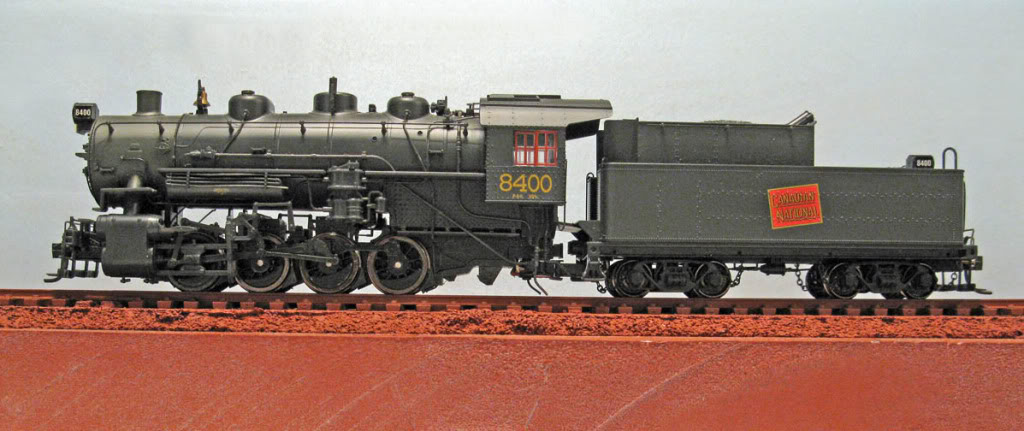
CNR #8400


Source : Doug Frozel (1959), cnrphotos.com, 2010.

Prototype :

Wheel arrangement: 0-8-0
Type:  Steam, coal burner
Class: P-5-h
Builder: Pointe Saint-Charles (Canadian National)
Year: 1930
Retired: 1959-1960
Scrapped: 1959-1960

Prototype background: None. This locomotive was assigned to a yard in Toronto, Ontario. Apparently retired and scrapped around 1959-1960.

Alternate history: Main switcher assigned to Limoilou yard and seconded by diesel-electric switcher #8469.
Model:

Wheel arrangement: 0-8-0
Type: Steam, coal burner
Origin: Prototype USRA (1918-1920)
Manufacturer: Life-Like Products (Proto 2000 Heritage Steam Collection)
Materials: Plastic and metals
Purchase: 2000 (Bazar des Trains, Québec), brand new.

Modifications: New red CN-style immatriculation plate under the headlight.


CNR #2191


Source : Doug Frozel (1959), cnrphotos.com, 2010.

Prototype:

Wheel arrangement: 2-8-0
Type: Steam, coal burner
Class: M-5-c
Origin: ex-CGR #212
Builder: Montreal Locomotive Works (MLW)
Year: 1913
Retired: 1959-1960
Scrapped: 1959-1960

Prototype backqround: None. This locomotive was assigned to freight trains in Mimico, Ontario. Apparently retired and scrapped around 1959-1960.

Alternate history: This locomotive hauled local train #420-421 on Bridge Subdivision between Hedley and Joffre yards.

Model:

Wheel arrangement: 2-8-0
Type: Steam, coal burner
Origin: Prototype USRA (1918-1920)
Manufacturer: Bachmann (Spectrum)
Materials: Plastic and metals
Purchase: 2010 (Hong Kong), brand new.

Modifications: New red CN-style number plate under the headlight and CNR decals.


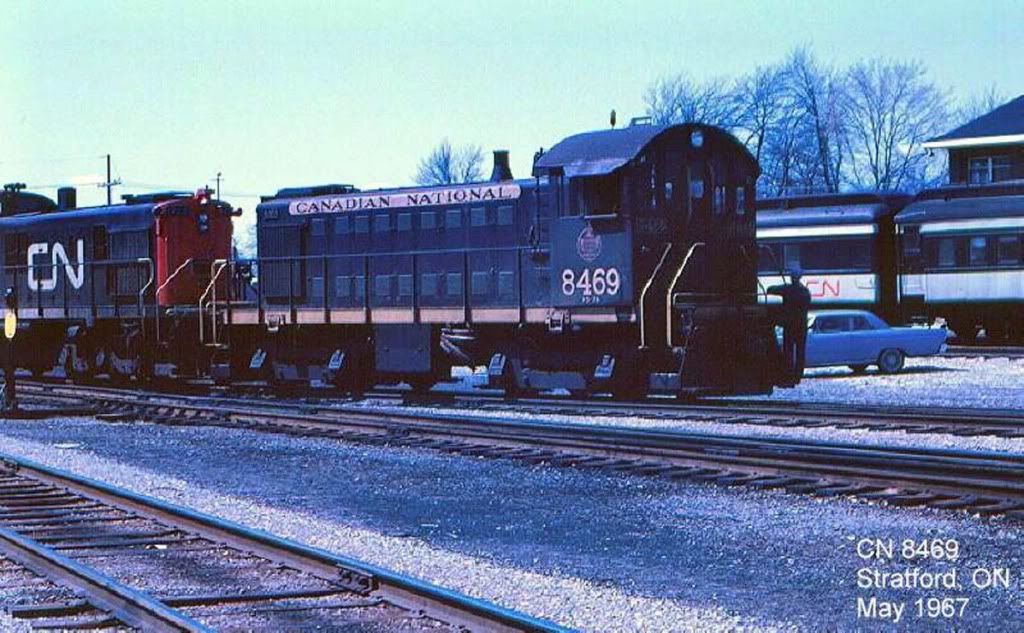
CNR #8469


Source : Don Jaworski (1967), cnrphotos.com, 2010

Prototype :

Wheel arrangement: BB
Type: S3, diesel-electric
Class: MS-7b
Origin: CN 8464
Builder: Montreal Locomotive Works (MLW)
Year: 1953
Retired: 1969
Scrapped: Unknown

Prototype background: None. Locomotive assigned to Strathford, Ontario.

Alternate history: Switcher assigned to Limoilou yard and used for local industrial switching.

Model:

Wheel arrangement: BB
Type: S3, diesel-electric
Class: Q-8-a
Origin: CN 8469
Manufacturer: Life-Like Products (Proto 2000)
Materials: Plastic and metals
Purchase: 2007 (États-Unis), brand new.

Modifications : None, detailling parts provided with the engine will be installed (sunshaded).


DW&P #3611


Source : atlasrr.com, 2010


Source : Paul Smith (1966), cnrphotos.com, 2010

Prototype:

Type: RS-11, diesel-electric
Class: MR-18a
Origin: DWP 3611 (then CV 3611)
Builder: American Locomotive Company (ALCo)
Year: 1956
Retired: 1985
Scrapped: Unknow.

Prototype background: This engine saw service between Duluth and Winnipeg from 1956 to 1965. It was transferred to Central Vermont (CV) from 1965 to 1968 then returned to DWP. Again, in 1979, it was transferred to CV and was repainted in their livery. It was sold to Quaboag Transfer (QT) in November 1985 and to Winchester & Western in October 1988. During its time with CV, this locomotive was a regular visitor at Richmond, Quebec.

Alternate history: In 1957, 3611 was transferred to CV and was, on few occasions, used to haul CV freight trains from Richmond to Quebec City via Danville Subdivision.

Model:

Type: RS-11 diesel-electric
Class: MR-18a
Origin: DWP 3611
Manufacturer: Atlas (Classic)
Material: Plastic and metals
Purchase: 2008 (United States), brand new.

Modifications : None.

Tuesday, November 30, 2010

"Cover this hole..." - Part 1

"...which I cannot behold" is a free interpretation of Molière's Tartuffe famous quotation! That's a fact, who wants his main line to punch the wall in such a brutal manner?


This picture show you the layout early stage in June 2010 with the first train to ever "run" on it. The hole at left leads to a hidden staging yard behind the furnace.


To conceal this horrible hole in the wall, I decided to go with the classic highway bridge hiding device.


In the real life prototype, there's a surelevated highway south to the yard called the Dufferin-Montmorency Highway 440. The first track in the foreground is the VIA Rail mainline, the second track is the freigh track connecting to Bassin Louise and Bunge Grain Elevator. The grey building, CN yard office, was approximately built where Hedley Junction Station once stood. The original Murray Bay Subdivision electrified double mainline was located between the yard office and the string of boxcars. As you can see, highway concrete piers block the old right of way.


Hedley Junction is no more

When the real highway 440 was built in 1976, Hedley Junction was completely redesigned to make room for the new concrete structure. At the same time, Palace Station closed and all CPR tracks removed. Passenger traffic having being rerouted to Sainte-Foy since a few years. In fact, the junction, built with passenger service in mind was no more needed since 1959, when QRL&PCo St. Paul station (Quebec City) was closed and electric interurban service abandonned.


Some 2000 feet of Murray Bay Subdivision original mainline were expropriated to make place for the highway and the original Hedley Junction (bottom right, left to the boxcars) was replaced by a new wye connecting directly to Hedley yard. This new wye was also useful to get access to a new yard built along the new (top right) and to turn VIA Rail trains.

However, this new track layout causes issues for future passenger service on Murray Bay Subdivison because a passenger train would have to work its way around the S-curve created by the wye and worst, it would have to travel on the yard tracks to reach Palace Station. Securing rights to run on these few hundred feets of track would be costly at least... and probably impossible since interurban service would disrupts freight movement drastically in this busy part of Quebec City Harbour. For this reasons, the future scenic train to Charlevoix (and its predescessor "Le Tortillard du Saint-Laurent") will have to use d'Estimauville Avenue as terminus, more than 3 km north from Palace Station.


It wouldn't be false to say this highway - supposed to be an avatar of progress in the 1960's - killed the train and all future prospects due to short-sighted planning. This Dufferin-Montmorency highway is now regarded as an urban disaster that cut the old city in two halves, razed completely the Chinatown, drastically altered Palace Station and accelerated the decay of St. Roch ward, once a thriving business district.

The model


Since the layout is set in September 1957 and highway 440 was built in 1976, we get a 19 years gap to fill in! No heresy here, just working a little bit with history. In fact, highway 440 was planned in the late fifties and the first sections, 6 km west to Hedley Junction, were built in 1962. If we fudge things a little bit, we can say it was planned, built and completed for summer 1957.


The model is based on the real prototype with overall dimensions calculated from Google Earth and Google Street View.


The deck, beams (stringers) and girders are made out out 1/4" MDF glued together. The side beam was shaped as a I-Beam on the table saw. All my respect for Louis-Marie for his madman woodworking skills!


Piers, road and side walls are .5mm and 1.5mm sheet styrene. Guardrails will be made out of structural shapes (Plastruct). Street lights are to be made out of plastic sprues and bits from the junk box. I thought about using LED, but that would have involved using brass tubing. Since we operate in broad daylight, it will be easier too improve their appearance without the electrical stuff.


Looks like switcher 8469 is already working hard under the new highway completed this summer. I'm not sure the boys can clearly foresee their archenemy is slowly but surely crawling out from its filthy nest!

Saturday, November 20, 2010

Presentation Of The Layout

The Hedley Junction Layout focus on railway operation located in Limoilou ward (former Hedleyville), Quebec City, Canada.

A Bit of History


Hedley Junction was once a major railway interchange between Quebec & Lake St. John Railway (future Canadian National Railway St. Raymond Subdivision) and Quebec Railway Light & Power Co. (future CNR Murray Bay subdivision) before a swing bridge was built on St. Charles River to get to Quebec City Harbour in 1890. At this very junction was the original QRL&P Hedleyville station welcoming pilgrims going to famous St. Anne de Beaupré Basilica.

Credits: Livernois, Train wreck at Hedleyville circa 1890, banq.qc.ca (2010)

On the following years, an important yard named Limoilou grew north to the junction. On the northern side of this very yard, on Canardière Road, was former Q&LSJ passenger station known as Lairet Station. The wood building, converted in a restaurant then in a pawn shop, survived until summer 2007. In 1919, Quebec Bridge was inaugurated and the Transcontinental Railway (future CNR Bridge Subdivision) linked for the first time Quebec City to South Shore and New England's railway network, ending an economic isolation going back to 1856.
 

The Old Layout

This layout replace the first club layout depicting the Bassin Louise (the harbour located on St. Charles River south shore) as it could be seen in the mid-50’s with its iconic Bunge Grain Elevator. It was completely torn down over the last months.


The original layout was U shaped with a swing bridge connecting both legs. First built in my grandfather’s basement; we moved it in one of our member’s own basement after humidity and temperature issues. However, the new room configuration wasn’t very forgiving and we had to knock down a drywall in the laundry room to maximize the space. Over 3 years, this layout quickly expanded in the adjacent room where Hedley yard and its roundhouse were first built. Finally, like a cancer in terminal phase, another extension spread into the garage through a 10 feet long amovible bridge. At this point, operation was at best an aimless nightmare. After many attempts to rationalize the trackage, we decided to start from scratch with a new shelf layout duplicating the possibilities around Hedley yard.


The New Layout

The actual shelf layout in HO scale is set in September 1957, according to an Underwriters Insurance plan issued that same month and year. Using different era-related rolling stock, it can easily be backdated to the 1930’s or operated until the early 1970's, since the area suffered from little changes during this era. Most of the buildings will be replicated full-size in styrene.


The new layout was completely designed according to the real prototype. As faithful as it can be with space available, it retains all the prototypical industrial trackage with a simplified version of the yard. We used Lance Mindheim’s design principles as a guideline and are largely indebted to him, even if he’s not aware of it! No wonder his work inspires many model railroaders all over North America and overseas.


Originally located outside the old city limits, north to St. Charles River, Hedley Junction finally became part of the downtown itself few decades later. The original trackage was built by visionnary railway contractor Horace Jansen Beemer (1845-1912), one of the best railroader of La Belle Province in the 19th century and sadly the most forgotten too. He developed the north shore railway network between Ottawa and Quebec City, including Laurentides and Lake St. John.