Tuesday, December 2, 2014

Rediscovering Wieland


My policy of keeping scenes as uncluttered as I can may be sometimes hard to apply. Most of the time what is planned on paper has little to do with reality. No plan survives the battlefield isn’t it?

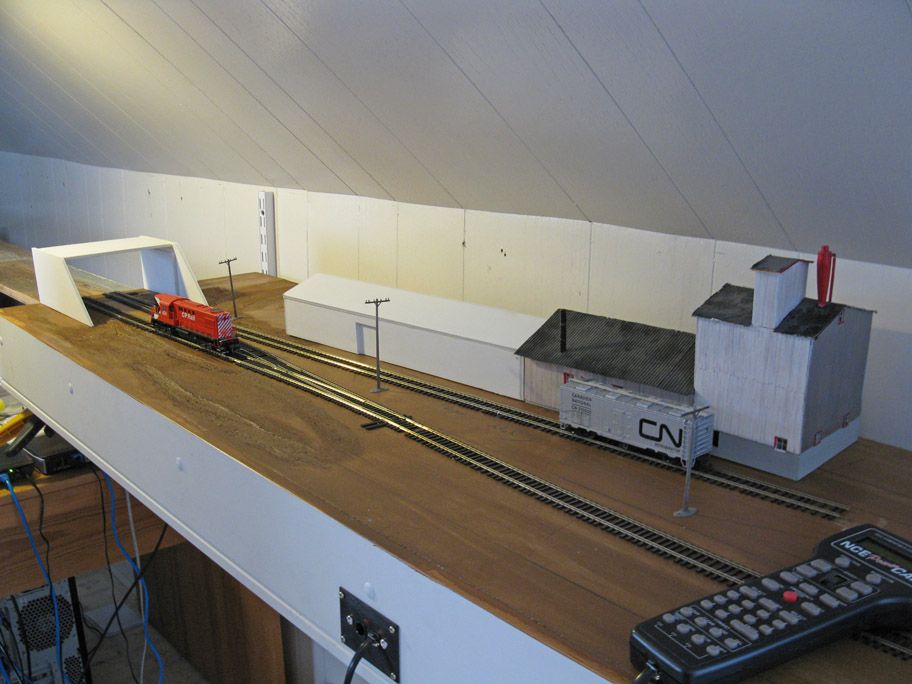
As you know, Clermont’s peninsula will probably be the site of our next large benchwork surgery. If we want to build the runaround there, radius must be bumped from 22 inches to 30 inches. That means the peninsula will be longer thus Clermont’s team track will also swell a little bit, which is a good thing.

Clermont in 1993 (credits: BANQ)
 While looking at old Murray Bay topographical maps yesterday, I found out many structures related to railway operations where located along Clermont yard and accessible from small service roads. In fact, there was no street between the track and the river at least until 1993 (the year CN sold off the line to Chemin de fer du Québec). This fact greatly changed my perception of this area. With the longer team track available, could I try to reproduce the farmer’s coop (feedmill)?

Wieland in 1959 (credits: BANQ)
Also, I could find out 4 large gas tanks once stood behind Coop Agrivoix, confirming there was once a rail-served oil and propane distributor. That makes sense because old pictures of freight trains from the 50s often have oil tank cars. I know another oil dealer, Imperial Esso, once stood in Baie-Saint-Paul too. By the way, I finally discovered that Wieland Station was in fact located near the feedmill where there are still a few sidings nowadays used for MoW. It makes sense. Until now, I always thought Wieland referred to Clermont’s wye. According to the maps, this wye was built after 1959.
 
Coop Agrivoix

The topographical maps shown me Coop Agrivoix building was substantially enlarged since it was first built. When I railfanned the area this summer with Louis-Marie, we took a few pictures of the building rear wall. We could easily see the original structure that is now hidden from the front street. Coop Agrivoix have 4 grain bin, a surge bin for trucks, an unloading pit and a large warehouse for supplies. A modern store was added on the south end. I wouldn’t model it, at least not in its actual size.


The layout plan above shows Coop Agrivoix original structures at scale. Not too deep – this is a good thing – but a little bit long… and reducing the team track capacity significantly. Also, having its public façade toward the hill makes no sense to me. On the positive side, the structure has appeal: bins, truck loading/unloading facilities, oil tanks.

Sainte-Anne's Coop (Google Earth)
That said, I tried to use another prototype: Sainte-Anne-de-Beaupré’s old Shur-Gain feedmill. This farmer’s coop was close down in the 90s. Murray Bay Sub only had two feedmills (to my knowledge); Sainte-Anne and Clermont. Shur-Gain feedmill is a smaller and older structure. It’s more bulky and there’s no grain bins and fancy stuff like that. To be truly honest, I once modelled this structure when I was a kid and it made frequent appearance on my layouts since then. The most famous iteration was Quebec South Shore Railway. The proposed concept for Clermont borrows a lot from this small switching layout. In fact, I must admit Clermont station would probably be switched following a similar pattern since handled goods are the same. Also, the prototype feedmill was located on a double-ended team track which, among others, handled also oil products. The structure was accessible from a small dirt road and a large parking lot/gravel lot was adjacent to handle other freight operation.

Sainte-Anne's Coop - Service side (Google Earth)
 
Thus, I decided to superpose this feedmill template on the track plan. Bad news, the mill is quite deep because of its large rear shed. However, all business was done front the left side of the building. It means the public façade is clearly visible from the team track and there’s no need to keep clear space for truck behind the building. The feed mill would be “nested” in the woods and adjacent hill. In Sainte-Anne, the feedmill is also (nowadays) surrounded by vegetation. All in all, this prototype fits the place best and keeps the team track long enough to be believable. And I have already the building in hands.


I have no idea if I will really add the feedmill at this point. Only a proper mock up on the layout will give us a definite answer. However, I must admit I prefer Sainte-Anne’s prototype. I used to railfan trains in the area and the building itself have its own personality. Not too modern, not too old (built between 1929 and the early 50s), not too big, not to small. Better, it was built on an existing team track, many years later.
My own rendition of Sainte-Anne's Coop (QSSR layout)
Looks like Clermont station will be a mash up of Wieland and Clermont yard... Scenery will borrow a lot from Clermont, but operations will probably be inspired by Wieland.
 
Stay tuned.

Monday, December 1, 2014

On The Road Again


Last Saturday, the layout nailed its last spike (for the moment) without fanfare. The event may seem irrelevant, but it ends a quest for a new layout that lasted well over a year. One year without “real” train movements. One year of trial and error… but that paid off quite a bit when you think about the effort involved in design.


Wiring is still to be completed and peninsula trakage will have to be relaid in code 83 in the future, but at least, the layout is 100% operable with all its customers and industries. Ciment St-Laurent plant is quite impressive with the long yard and sidings. This is truly a emblematic scene and I’m quite proud to say I didn’t use any selective compression on buildings. The longest siding is about 16 feet long!

Meanwhile, I also started to bash Atlas telegraph poles into typical Murray Bay Subdivision poles. The prototype was quite simplistic, only one cross arm, but there’s more history behind it. These poles started with two cross arms full of insulators, but as telegraph became obsolete, the upper cross arm was removed. By the end, only two insulators remained. They were used to carry two wires controlling grade crossing signals. It may seem an unimportant detail, but when you put it on the layout, it really gives a sense of place. Also, I took care to place them 130ft apart (about 18 inches), just like the prototype.


I also put in place the steel electric poles running along the cement plant. Those were put in place in the 50s to replace wooden catenaries. With all these specific poles back in place, hard to not feel you are indeed in Villeneuve.


We still have a lot of work to complete, but things have settled down and I’m looking forward for the first prototypical operating session during Christmas vacation. Now, I should concentrate on completing the photo backdrop before that time.


We also built the unloading pit for coal and gypsum using 1/8" MDF and window screen. Simple but effective.


And a few scenes, including a GE 45-ton shoving cars under the silos and the cement plant lead track.


By the way, it has been discussed to connect the scene into the furnace closet holding Villeneuve turnouts with Villeneuve scene. There are many reasons: an overpass will be too intrusive, the closet trackage is already visible from the layout room and we have to see clearly what happens there while switching. A part of the wall will have to go away.

 
Just like the prototype, the closet scene will be the site of Brique Citadelle. In the past, I already bashed a few structure kits into this brick plant, so I plan reusing part of it. Once again, I’ll have to visit the archives to find pictures of the plant during the 60s, 70s and 80s.


Saturday, November 29, 2014

Pourquoi un blog rédigé en Anglais?

Lors de l'inauguration de ce blog, j'ai eu à me poser la question fondamentale à savoir s'il serait écrit en français ou en anglais. Par soucis d'universalité, puisque l'anglais est en quelque sorte le latin des temps modernes qui permet de transcender les cultures, le choix qui s'est rapidement imposé fut la langue de Shakespeare.

Quelques francophones m'ont questionnés à ce sujet dans le passé. N'était-ce pas là un geste d'acculturation, d'autant plus étrange dans le contexte québécois? Peut-être, peut-être pas? Hier, à la radio, une jeune compositrice-interprète québécoise expliquait qu'elle souhaiterait écrire des chansons en français, mais que pour le moment, l'inspiration lui venait plus facile en anglais. Cela m'a refait penser à ma propre situation.

En effet, la technologie ferroviaire est arrivée au Québec par le truchement des Britanniques et des Américains, bien après le passage de la France. Ainsi, la plupart du vocabulaire ferroviaire a été transmis en anglais, déformé en français ou tout simplement traduit localement, indépendamment des termes utilisés dans l'ancienne mère-patrie.

En ce sens, il est donc difficile de décrire la réalité ferroviaire québécoise dans un langue française pure et qui est agréable à lire. De plus, le recours à des termes français exacts n'aurait pas toujours de résonance concrète aux oreilles du lectorat local.

J'ai souvenir enfant que nous utilisions de manière interchangeable divers mots français et anglais. La "track" était souvent préférée à "voie ferrée", mais en revanche, plusieurs mots français étaient courant. Le contact avec les railfans et les cheminots m'ont fait adopter, à mon insu, le vocabulaire anglais, beaucoup plus utilisé par les gens près du chemin de fer que par les néophytes. Ainsi, je n'utilise presque plus "wagon de queue", me contentant de "caboose", je ne parlerai même pas de "van", canadianisme qui semble être une particularité de nos concitoyens anglophones. De même, les expressions "charrue" ou encore "gratte" (dans le sens canadien de "chasse-neige") ont été remplacées par "plow" ou "snowplow". Pourtant, il serait facile de rédiger un texte en français.

Là où le bât blesse, c'est lorsqu'on plonge directement dans le vocabulaire propre au modélisme ferroviaire. On entre dans un univers assez étrange. En effet, tout québécois qui tentera de lire un livre spécialisé français risque d'avoir un choc culturel difficile à surmonter, il en va de même dans l'autre sens. Les réalités géographiques et matérielles des deux continents sont fort différentes. Rien que dans le département du matériel de bricolage, on s'y perd. Qui saura ce qu'est du "Depron" ou du "plume"? Parlez de carton à un Français, il imaginera une boîte pour déménager, pour le Québécois, ce sera naturellement la matière première et jamais il ne songera à une boîte. Même chose pour le sens de "maquette". En France, une maquette est un terme qui peut prendre un sens signifiant à peu près n'importe quoi qui est reproduit à l'échelle. Au Québec, une maquette signifie habituellement quelque chose de plus complexe qui est de la taille d'un réseau, d'un diorama ou encore d'un bâtiment, au sens architecture. Pourtant, pour un français, une maquette peut effectivement décrire une réalité comme une figurine en résine. Ainsi, pour décrire une figurine de Batman à monter soi-même, on dira une "maquette en résine". Ici, cela tomberait sous le porte-manteau du "modèle réduit en résine". Mais ce phénomène n'est pas propre à la francophonie, il est universel entre les locuteurs d'une même langue qui vivent dans des conditions différentes. Il en est de même entre les États-Unis et l'Angleterre. Quiconque fait le pas entre les deux doit s'attendre à réapprendre la moitié du vocabulaire et à sauter des unités de mesure métriques aux mesures impériales. Heureusement pour nos canadiens, aucun des deux systèmes n'a réussi à supplanter l'autre et nous sommes, pour ainsi dire, bilingues en unités de mesures, maîtrisant l'une et l'autre et n'hésitant pas à les utiliser de façon simultanée.

Mais pire encore, c'est lorsqu'on tombe dans des termes intraduisibles tels que "scratchbuilding" ou "kitbashing"! De nombreux Français ont tenté sans succès de traduire ces mots. Chaque fois, c'est un fiasco. Pourtant, le concept est simple: "construction à partir de zéro" pour le premier, et "combiner des modèles" pour obtenir quelque chose de différent de l'usage souhaité par le fabricant. Bien entendu, ce sont des concepts simples basés sur une différenciation des matériaux de base utilisés: soit on part de matériaux bruts, soit on utilise des matériaux commerciaux, préférablement des kits. Pourtant, ça ne passe pas en Français. Je veux dire par là qu'il est impossible de résumer ces concepts à un seul mot unique, comme en Anglais.

Un autre mot qui perd des plumes, c'est "weathering". Il s'agit de l'action du temps  et des éléments sur un objet, sa dégradation et son défraîchissement inévitable. En français, nous avons le merveilleux terme de "patine" qui explique la même chose. Pourtant, dans l'esprit des gens, le mot patine a une connotation positive, nostalgique. On parlera de la belle patine verte du cuivre, du grisonnement du vieux bois. Bref, des évocations plutôt sympathique. Pourtant, cela manque le côté brutal du terme anglais, qui ne cherche pas à embellir mais simplement décrire. Étonnant comment deux termes pourtant identiques et équivalents ne passent pas la même charge émotive.

Finalement, un autre point est le lectorat. La plupart des gens de France qui lisent ce blog ont une affinité certaine avec le modélisme ferroviaire nord-américain, ces termes spécifiques et une maîtrise suffisante de l'anglais. Quant aux Américains et Canadiens anglais, ils forment une grande partie des lecteurs, il est donc normal de s'adresser à eux. Et puis, vous seriez surpris, mais de nombreux lecteurs sont originaires d'endroits aussi différents que la Chine, la Roumaine, l'Allemagne, l'Afrique du Sud et la Russie. Nous avons tous en commun un moyen de communication qui nous permet de transcender nos cultures et il s'agit de l'anglais actuel, celui du web, cet anglais décomplexé et dépolitisé que j'ai comparé plus tôt au latin du Moyen-Âge, ou encore au Grec de l'Antiquité.

Pour toutes ces raisons, ce blog est rédigé en français. Cela est aussi une excellente occasion de pratiquer l'usage d'un langage que je n'utilise virtuellement pas dans mon quotidien.

Néanmoins, j'avoue être le premier à déplorer que l'histoire ferroviaire du Québec est trop souvent écrite par les Canadiens anglais? Est-ce un reproche? Non, en fait, il est fascinant de ce dire que cette histoire, qui nous semble limitée, soit pourtant perçue par plusieurs de nos compatriotes comme d'une importance nationales. Cela n'est pas non plus une question d'ignorance. J'ai eu l'occasion de rencontrer de nombreux francophones qui sont de véritables encyclopédies sur pattes. Malheureusement, il semble que la notion de mettre à l'écrit et de compiler les connaissances ne soit pas très valorisées dans notre culture. Des centaines d'excellents livres potentiels disparaissent chaque année à la mort de ces mémoires vivantes. De plus, le fait de lire sa propre histoire à travers l’œil d'un anglophone ne nous présente que la moitié de l'histoire. Souvent celles des promoteurs de ces lignes et de politiciens influents, mais rarement du point de vue des gouvernements locaux, des constructeurs et de l'impact réel dans l'évolution du territoire local. Pourtant, c'est là l'aspect le plus concret de l'histoire ferroviaire, celui qui permet d'en tirer des leçons. Dans le meilleur des mondes, l'histoire des chemins de fer au Québec devrait nécessairement être écrite par des concitoyens des deux langues afin d'avoir un portrait global qui va de l'intérêt local jusqu'aux visées internationales de ces entreprises tentaculaires.

Sur ce, je remercie tous les lecteurs francophones de ce blog et je prend la peine de dire que je ne les ai pas oublié. D'ailleurs, ils remarqueront que depuis quelques semaines, j'ai cessé de traduire les noms d'entreprises ou de localités français lorsque je décris le réseau.

Tuesday, November 25, 2014

Delving Into Archives


Last Friday, I visited Bibliothèque and Archives nationales du Québec (BAnQ) located on University Laval campus. Browsing through their web-based database, I found out they had an interesting photo-report of Ciment St-Laurent plant in Villeneuve dating back to 1958. So, I decided to pay them a visit after work.

Unfortunately, there was no photo in the archives, only negatives. But it was better than nothing and equipped with a light table, I could have a glance at them. In fact, the inverted black & white shades gave them a surrealistic look and a genuine artistic value. The plant – as originally built – is truly an industrial architecture gem. No wonder the photo-report was commissioned by Inventaire des Oeuvres d’Arts du Québec, a now defunct government entity that recorded past and present cultural artefacts in Quebec. Such an inventory still exists in the United States. Unfortunately, Canada and Quebec in particular are always quick to dismiss their own history and identity. I won’t turn that into a political feud – which I always find unproductive – however, there’s always something disturbing about people unable to face themselves in the mirror. It always makes me smile when I hear intellectuals say we are a “new” country with little history, almost a blank sheet of paper you can write everything you want… Well, get real, it’s been over 400 years now and there’s more laying under the surface than one could think of!

That said, information gathered from the negatives is impressive. First of all, the property wasn’t fenced at all back then which made the impression Villeneuve was a 7-track yard (there was no delimitation between private and QRL&PCo tracks). Many types of cars could be seen under the silos, including 40ft OSB wood boxcars, 40ft steel boxcars, slabside hoppers and braced covered hoppers from early CN experimentation with this type of cars. About half cars were boxcars, which is quite impressive but not surprising for that era.

Other pictures shown glimmering rails under overhead wires with silos silhouettes in the background. A nice shot was taken from the back of the plant. Bulk cement semi-trailer trucks were emerging from the silos substructure while railcars were shoved in the background. Interesting pictures included also close up views of conveyor, coal storage area, overhead crane and track scale.

I was particularly impressed with the offices and machine shop buildings. I knew them in their last years, but they indeed were very interesting modern piece of architecture with very slick lines, generous glazing and clean siding materials. I’m not a fan of this architectural era, but I must admit you could sense some thoughts were given when designing them. Unfortunately, industrial pollution, dust and cement particles quickly covered them and we only remember them as grayish dusty boxes with faded green trims. Later modifications wiped out any remaining architectural interest they had retained.

BAnQ staff was kind enough to offer me to scan the pictures, but at 20$ per scan, it would have been quickly prohibitive since about 20 pictures were worth reproduction. Also, when I explained I was working on a scale model of the plant, they told me if I worked with their pictures, I would need a licensing agreement to show the model in public or publish work about it. I find that claim quite dubious since it means most people detailing cars from archives couldn’t publish their work without such licensing. It makes no sense to me, since the model would be mainly designed from other source material like Insurance Maps, Google Earth, Bing Maps, personal pictures and from other people. Anyway, I preferred to not venture in that mined field!

When leaving BAnQ, it was clear that modelling the offices and machine shops would be a must on the layout. Fortunately, Bing maps have recorded these building just before they were slated for demolition a few years ago. It’s more than enough to make a decent model of them.


Now, the real issue is finding a way to get a decent picture of the kiln building in the background. Most pictures of it are low resolution and heavily slanted. Even in Photoshop, there’s little to do about them.  And if you talk about the kiln, you also need to put in the large kiln stack that towered at 450 feet. My grandfather built the foundation forms of that stack back in the mid-50s. I remember he told us he was a little bit sad it was destroyed after only 50 years. He was told, back then, it would last for a least a century. It was his first important jobs when he moved from Charlevoix to Quebec City. So, for now, my best bet is to find a similar industry and photoshop it into something similar to my prototype.

Sunday, November 23, 2014

Completed mainline

Mainline is back in service. The last stretches of flextrack were laid yesterday, completing the staging. Also, Ciment St-Laurent trackage is now starting to take shape and the unloading pit for coal and gypsum is now in place. So far, only 28 feet of tracks need to be laid and this part of the layout will be completed.


It's been a real long time since the entire layout was functional and it's great!


Also, you remember my posts about equated tonnage rating for locomotive and adding weight to freight cars? We moved some trains yesterday and it became extremely clear a train would stall if you didn't add the suitable motive power. You could really sense the locomotives were trying to move heavy railcars, making everything more realistic. Also, if you were able to move a long train with one engine in Villeneuve, it didn't mean it would be enough to handle the serious curves in Murray Bay. Once again, physic laws were well scaled down by adding weight in cars.

It was also evident the small Bachmann GE 45-ton will be a little bit weight in the cabs to be able to put a typical 6 cement cars consist.

Moving trains over Hedley-Junction layout is now longer a matter of playing with toys but rather a matter of moving freight cars with optimal efficiency.

Sorry, no picture this week, I forgot my camera at home...