Saturday, May 7, 2016

Trailers - Setting the Era

Nothing set better an era than road vehicles. During my last trip to a hobby shop, I purchased four trailer trucks, including a bulk one.

Trailers are an ubiquitous sight of industrial areas all over the world, this is particularly true with paper mills and similar rail-served customers.

For such reason, I decided to get rid of my idea to place an office building at Donohue and instead make a mundane semi-trailer parking lot. Yes, it’s the easy way… but it’s also the realistic way. Also, most people easily recognize road vehicles and get a deeper sense of time and era than looking at locomotives and structures.

I’ve been trying to assemble a credible fleet of trailers over the last year. Most of them need to be repainted and get new decals. To be honest, most are proxies and not very accurate models, but it shouldn’t be too much a distraction since the right lettering, colors and level of weathering are much more important.  My goal was to strip their garish paint schemes and replace them with more correct ones.


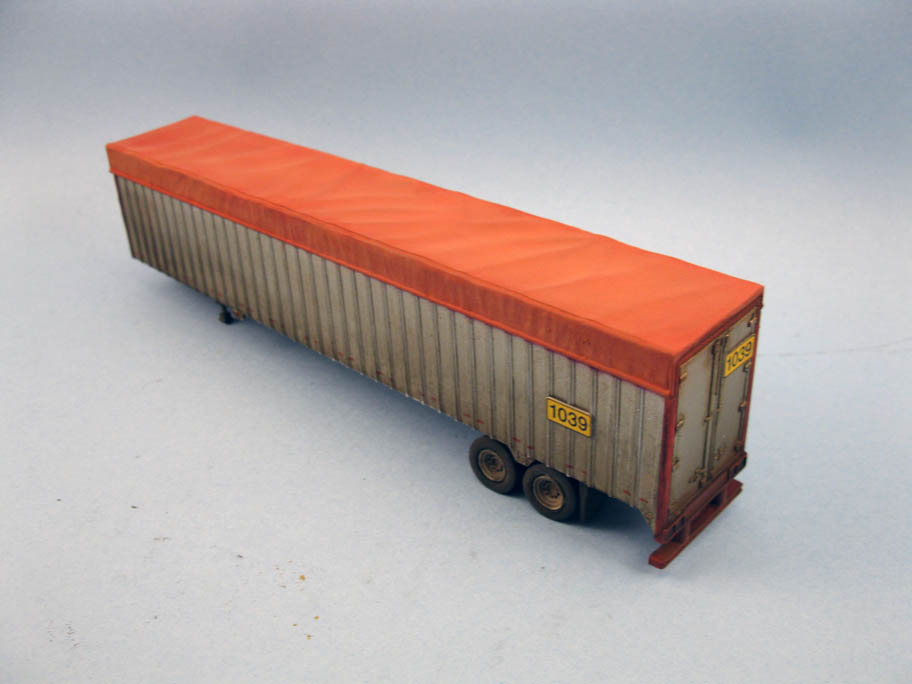
So here's the result after decalling and weathering them. Getting prototypical Quebec-area trailer decals isn’t an easy task. While Rick Decals makes a very neat line of trailer decals, most are only suitable for the 1990s-2010s era. But yet, they still make two interesting sets that I used.

The first one is a generic woodchip traile. The red color is quite common for these trailers in Quebec area and I made yellow numberboard as can be seen on many local companies woodchip trailers.


The second one is for TNT Overland Express and is suitable circa 1987. It was the result of several express companies merger at that time.


Thethird one is for Steinberg, a famous and now defunct supermarket chain that pioneered this business model in Quebec back in the 1950s. The chain was a gigantic empire that crumbled like a card castle over a sour succession feud. The Steinberg trailer is important to me because the demise of the chain in the very early 1990s clearly indicates the layout is set in the 80s without any doubt. Also, there was a large Steinberg supermarket located on D’Estimauville Avenue back then.  Simply put, Steinberg trucks would have been a daily sight at the grade crossing.


The fourth one is a Woolco trailer. Woolco used to be a large department store chain under Woolworth umbrella. While the American chain got defunct in the early 1980s, the Canadian counterpart survived well into 1994. A very large Woolco used to stand on D'Estimauville Avenue by the track. I remember visiting that store on a regular basis with my parent back then because it was the nearest one in our vicinity. In fact, Woolco is the main reason I have many memories from the old Murray Bay Subdivision in Beauport because we used to drive along the track for many, many miles. Of interest, Woolco was part of a now destroyed shopping center called Les Galeries Sainte-Anne. More about that shopping center on later posts, but keep in mind I'm actually in the process of replicating the large parking lot that was located by the track.

The Woolco decals are custom made from crappy pictures found on the Internet. Deciphering the black lettering required some serious Photoshop tweaking! The result isn't perfect when observed from near, but from a normal distance, it's OK! By the way, I removed the stock hinged doors and replaced them with a rolling door per prototype.


Among other trailers not picturesd here is the Bourassa one which I backdated by removing the web address and aerodynamic flanges.  There is also the CN Supertherm one and an old and original RONA trailer made by Majorette circa 1986. I have three of them which were sold back then in RONA stores (hardware). Me, my brother and my sister had each one. At 1/87, they are fairly decent model for their time and the Kenworth tractors are relatively nice for background models.


Monday, May 2, 2016

Montmorency Falls Station - Part 5


Greg asked in the previous Montmorency Falls Station if he could get a copy of this station... but would he still want such a run down station?

That said, I had a lot of fun completing the project.

First, I painted the model with the correct colors as it was when the station was remodeled in the late 1950s.


Then, I fast forwarded to the early 1980s and faded the paint with a coat of diluted dirty white. As you can see, every plywood in windows was masked with tape. The goal is simple, keep the boarding up free of weathering to show the station was closed down relatively after years of gradual disrepair.


Only after that step, it was time to apply the roofing. A few years ago, when I was building Limoilou Station I purchased some black asphalt shingles made by Rusty Stumps. The product is self-adhesive and well-known among modellers. Before installation, I pre-weathered the material with weathering

At first, I wasn't that much convinced by the product, but after a few rows, it was evident it was an excellent option. My only complain is about the ridge caps strips which are weird at best and need some serious trimming to looks good.

Once the roof and chimney were done, the roof was heavily weathered with diluted and full strength oil paint. Now was the time to age the structure further A coat of diluted oil paint was applied to the building. The temptation to overdo the weathering was there, but I kept following the prototype pictures to make sure it wouldn't look like a total wreck..

Here's the result:


Wednesday, April 27, 2016

CN Woodchip Gondola - In Service


Finally, the dreaded woodchip car made its revenue service debut last weekend during an official operating session with guest operator Julien Boily. With very limited knowledge of the subdivision, he was still able to perform quite well the task to run the train up to Clermont.

Things started to get spiced up when he had to deal with Donohue, which is truly a challenge even if it looks quite tame at first sight. Nevertheless, Julien never lost his cool and found his own original way to switch the plant, once again proving you don't need a lot of turnouts to generate lots of interest.

Julien taking a pause to think over the next move in Clermont.


Funnily enough, it was the first time since we started rebuilding the layout back in early 2014 that a guest did operate the layout in a serious manner. I was quite pleased to see Julien enjoyed his time on the layout and found it interesting.

Most Canadians used to think modelling our country railways needed huge space to get the feels of large open spaces, but it seems the mid-sized realistic layouts are taking roots and prooving their worth.

While operating, we had a nice discussion about the future of Canadian models on the market, mainly such obvious things as the CN Transcona woodchip gondola. Julien himself own a large fleet of woodchip gondolas - mainly Walthers proxies - and would probably buy a dozen if they were available. Once again, one wonders why such a staple car seen from coast to coast for half a century isn't available. Mystery! Anyway, I succeed to convince another man MLW M420 should be the next big Canadian locomotive announcement!

Meanwhile, Mathieu Gosselin was also among us with David that evening. Mathieu decided to bring his new Vermont Railway locomotive to test it on the layout and we took an official picture over Malbaie River bridge. Once again, I must admit Athearn did an outstanding job with this model.


David did some operation by switching Ciment St-Laurent and doing some transfer move between Villeveuve and D'Estimauville.

As for Jérôme, he has now engaged himself on a slippery slope: adding weight and sound to a Bachmann GE 45-ton locomotive. I'm not sure you can have both, but he did some pulling power testing. The results are encouraging, but on the other hand, our Bowser hopper fleet will need a serious rebuilding program. So far, the locomotive is able to pull about six 10 oz. hopper cars, which is our goal. At some point, we believe the answer will be a compromise that will require a slight weight reduction of the cement hoppers. Maybe I went a little bit overboard with the weight, but I'd rather alter the locomotive than remove weight if I had to choose.

Finally, Louis-Marie and I agreed to start scenery work at D'Estimauville since the area is the less challenging and the one ready for such work. The track is already ballasted and painted. The initial work will be to scratchbuild roads before proceeding to ground cover. I've got quite a precise idea of what I'm trying to achieve and Jérôme gave some interesting advices on a realistic way to build D'Estimauville Avenue.


Saturday, April 23, 2016

Montmorency Falls Station - Part 4

The new station in context.
 
The project is moving forward nicely I must say!


I recently made the roof overhang brackets. Once again, the good old trick of using template save a lot of time and headache.


While the brackets were drying, new fascias where cut and cemented. Too make things easier, I measured exactly the roof dimension and made the gable's fascias as one part.


The next was to install new beams under the roof on which the brackets will rest. It went easier than expected. I laminated 3 strips of styrene cut to length. The final adjustment was done using a file rather than trying to make a perfect piece from the start. There are times like that were incredible precision is more a hindrance than an asset.


 At this moment, I was ready to install the brackets. Using an X-Acto blage, I chamfreined the bracket's diagonal members. It may seems a very small detail, but it has an impact in making the brackets look far less bulky.


Unfortunately, while looking at old pictures, I found out the station had more brackets than I first thought. At this point, I have two options: make the missing brackets for the invisible rear wall or let it be because nobody will ever notice... My inner conscience tells me I shouldn't cut corners!


Finally, I added small trims under the soffite to make a nice junction between the walls and roof. This is also another small detail that is a difference maker when building scale structure.

So now, only a few remaining brackets and the bow window roof needs to be addressed prior to painting and adding the roof material.

Wednesday, April 20, 2016

Montmorency Falls Station - Part 3


This project is running smoothly and yesterday was another busy day. Four hours of work were required to put together the small bow window in front of the station. While it is a very small feature, it required extra care when laying the masking tape. Truth to be told, the smaller the surface, the harder it is to make it perfectly straight because of the nature bulge occurring when the tape goes around the corners.


For this reason, I decided to install the tape cladding first, then cut the window openings later and add the window trims last. It did work OK even if it wasn’t perfect.


When the bow window was done, I set it in place on the station and using a brand new X-Acto blade, I cut the cladding along the bow window’s profile. It resulted in a perfect and seamless match between the two parts. Then I cemented the bow window once for all.


A final coat of Krylon tan camouflage paint blended everything together. I’m planning to use this color as a base for the concrete foundation. In the past, I got excellent results using this particular color for old weathered concrete. It had this particular shade of tan that mimick perfectly when sand aggregate in older concrete is exposed by weathering process.


The roof is made of 1.5 mm styrene. I made a 3D model in SketchUp of the structure as built and determined the exact size of each part to make sure the parts would fit without guess work. When cemented in place, I scribed 0.25 styrene sheet to make soffite material. It was then cut to size in place and cemented. Some adjustements will be required to make sure everything fits perfectly before installing trims and gutters. Even if you work with precise CAD drawing, you are bound shim here and there.

For the roof, I’ll use Rusty Stumps auto adhesive asphalt shingle products to save me from severe mental pain. It was supposed to be used for Limoilou station in a previous iteration of the layout, but that project was abandoned long ago.