Thursday, December 12, 2013

Saint-Sacrement Station – Good Enough! – Part 1


Sometimes, you just need to call it good enough to move forward. It’s more about knowing where your efforts pay the most.

Saint-Sacrement station is a now abandoned modern station located in St. Malo industrial park in Quebec City. It was built by CPR in the wake of Quebec City downtown urban renewal when historic and iconic Palace Station – built to fit Château Frontenac architecture – was closed down and slated for demolition. Don’t ask me what those people where thinking, but feel safe, Palace Station survived in this ocean of destruction and reopened later under VIA Rail.

The new station was/is a spartan building design in a dirt cheap brutalist architectural style. Forget fancy brick and wood work from old times; forget modern free layout plan and flowing style. It had none; just a cheap stand-in for a dying transportation mode.

As bad as it was, it still had some charm from a modeller perspective, including a piggyback terminal, a gritty industrial setting and a signal bridge! Why the signal bridge? Because they are seldom found in Eastern Quebec were single-track mainline is the rule. When you think about signal bridge in the area, you automatically think about CPR mainline East to Allenby in Quebec City.


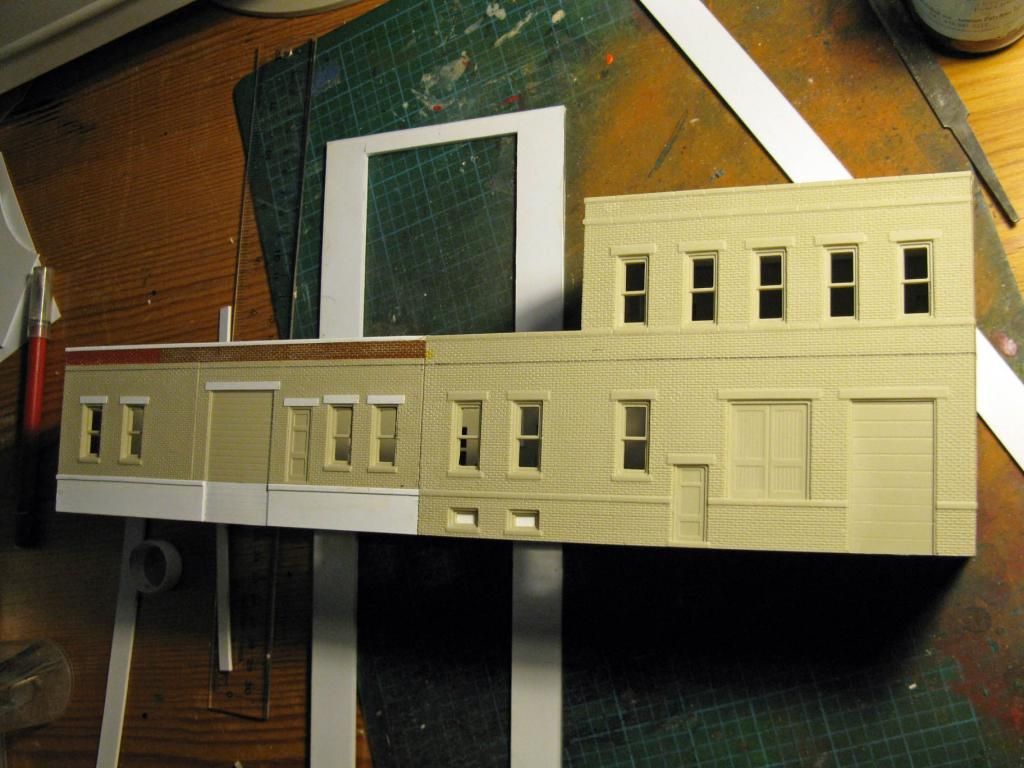
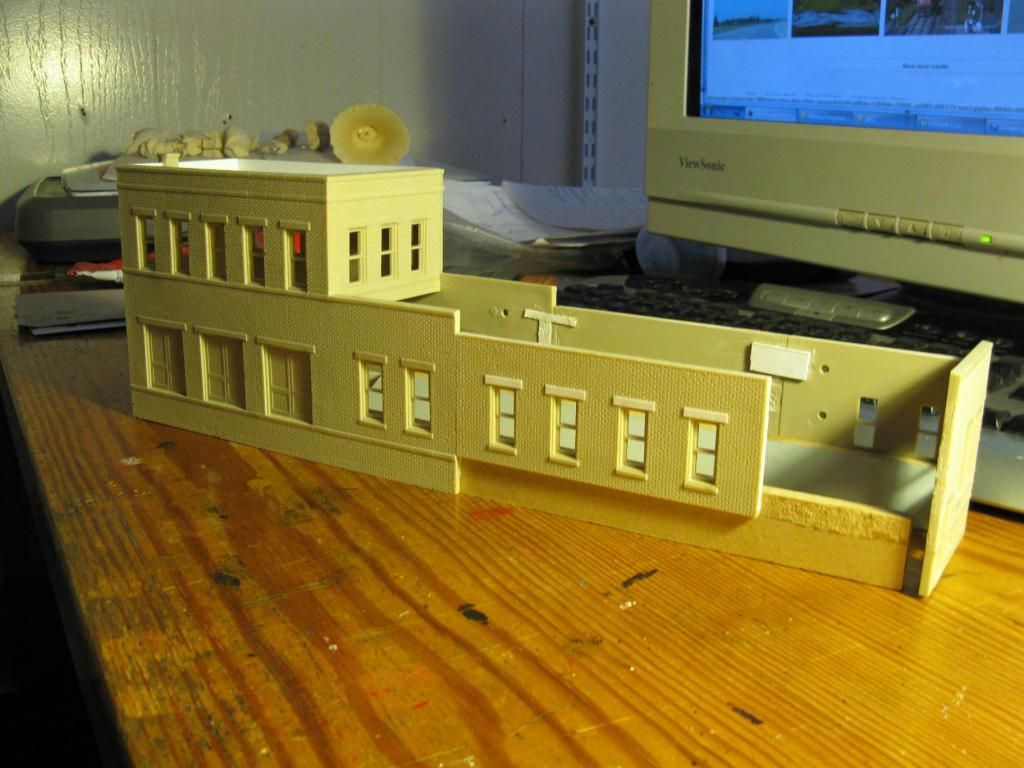
Anyway, when came the time to model the station, I automatically thought about a half-finished kitbash of DPM generic structures (Cutting Co. and Taxi Cab). Originally, it would have been a factory on an ill-fated switching layout but I felt it was fine material to depict a modern freight-oriented station. In fact, it reminded me ex-CRP Farnham station located in Southern Quebec (home of now infamous MMA’s Quebec operations).

Farnham Station was built in the early 50s, replacing a grandiose burn down structure from Victorian era. Not a masterpiece, it’s not an ugly duckling either. Honestly, it has charm with its pure brick and stone lines; a perfect prototype for a dying CPR line in downtown Quebec City.


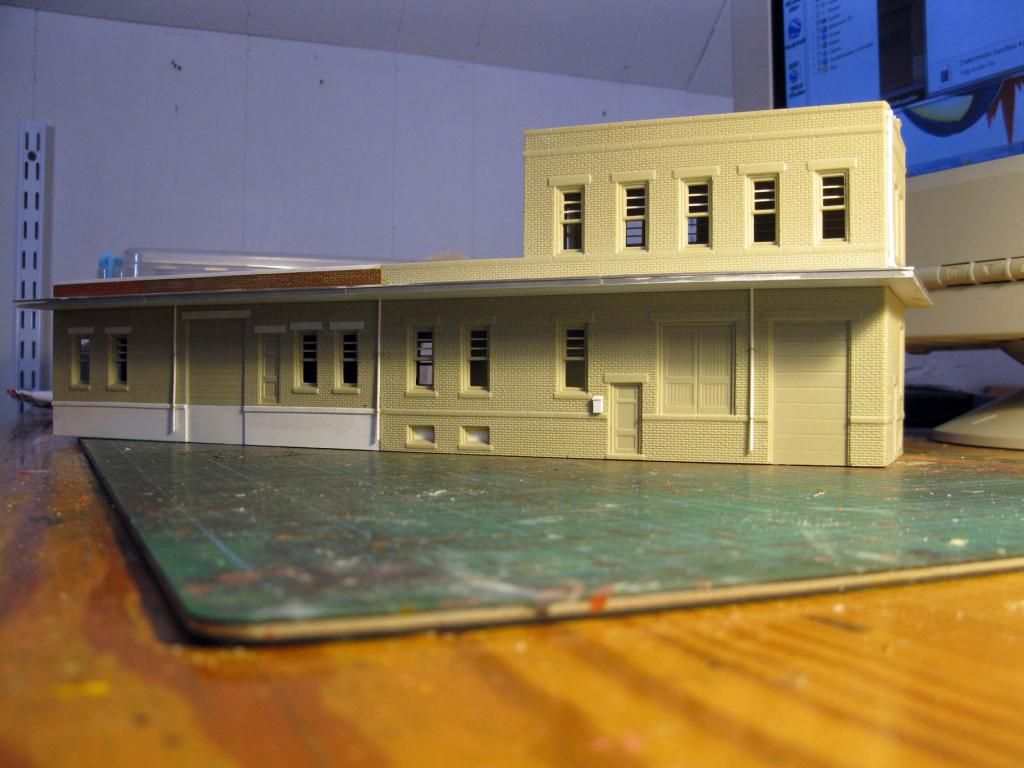
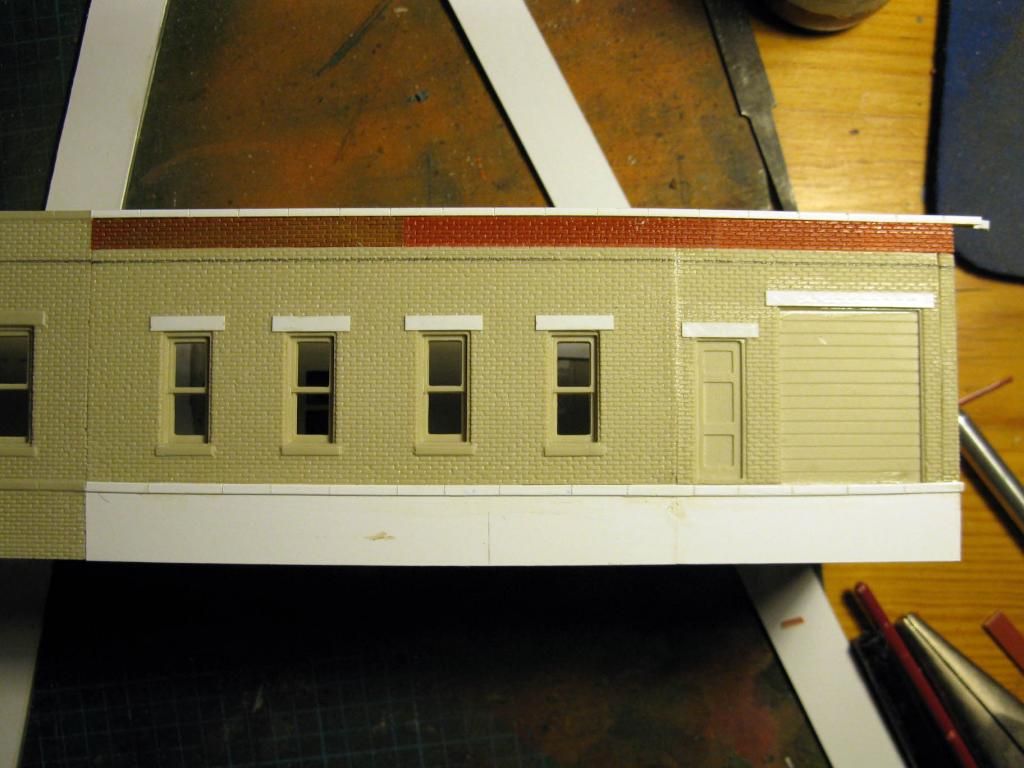
The DPM bash, with its two-storey office and station and a one-storey warehouse was perfect to fit the bill. But to get a modern flavour, it definitely needed large and gracious steel over hanged roof so typical of the era. Using laminated styrene sheets and Evergreen roof cladding, I easily made one similar to Farnham. It totally changed the look of the building, helping to hide its DPM origin.


Another crucial detail was windows. Often, in the 1950, it was popular to had horizontal mullions on sash windows to express better a sense of horizontality and speed so dear at that time. It was done by gluing thin strips of paper on the back of the structure with solvent cement. Yes, solvent cement is an excellent bonding agent between porous material like paper and styrene when used with care.


Downspouts and electrical wiring were added to the structure to hide non aesthetical seams and give some depth and realism to the station. With most bashing done, only painting and adding small details such as railing and light fixtures are left. Stay tuned!

Tuesday, December 10, 2013

Streamlining your intentions: "Less is more" approach to track planning


The layout design is now more than 3 years old. Many concepts, ideas and revolutions took place since the first run, but I’m quite pleased by the fact my original design still stands its ground so far. At least, I like to believe it…

I remember when I planned it all back in early 2010. At that time, I was playing avidly OpenTTD, a classic 90s computer game about transportation. It was a revelation because before playing that game, I only focussed my model railroading in replicating what I saw. How trains looked was important but I gave little thought about how they operated.

OpenTTD isn’t the paragon of realistic operation, but at least, it’s rational. At some point, my rail network grew beyond my limited knowledge of railway managing. What a mess it was! It took me hours to learn about signals, orders and many other neglected aspects. Soon, stations and yards grew in size but also became more effective and fun to run. Mainlines, branchlines and sidings now had a purpose. Better, the invested money started to pay off. Want a thrill to see these hundred trains running through the land, delivering goods in a timely manner. To me it all became clear: operation was fun! So much fun it was also a food for thoughts instead of a cosmetic hobby like other modelling. This game sparked my renewed interest in model railroading big time. Lessons learned virtually had to be applied to the “real” modelling world… I was ready for a challenge and Hedley-Junction layout was soon to be born.
Small but effective, the new layout was built around a desired flow of operation inspired by the minimalist CN Lairet Subdivision in downtown Quebec City. Tracks needed were identified, their role defined and relation between them established. From that sketch of interactions a new yard – Limoilou – was born. A small yard I’m still proud of after many operation sessions. A yard that survived all makeover schemes since then. I could hardly add a new track; I could hardly remove a single track. It’s not perfect, but to be honest, it perfectly fills in the role it has been designed and built for. It’s all about pertinence!
On the other hand, I had quite a hard time settling on an efficient pattern of industries. Honestly, too much ideas, too little place… Or to be exact: too much conflicting ideas for a given place. I was afraid to make things clean and logical like the yard. I went for the anecdote instead of brushing an overall operating scheme. And you know what? I knew all about it from the start… but couldn’t accept the cold hard facts. Man, we like to fill up every little empty space! Almost a phobia!

 
The ill-fated St. Lawrence Cement plant

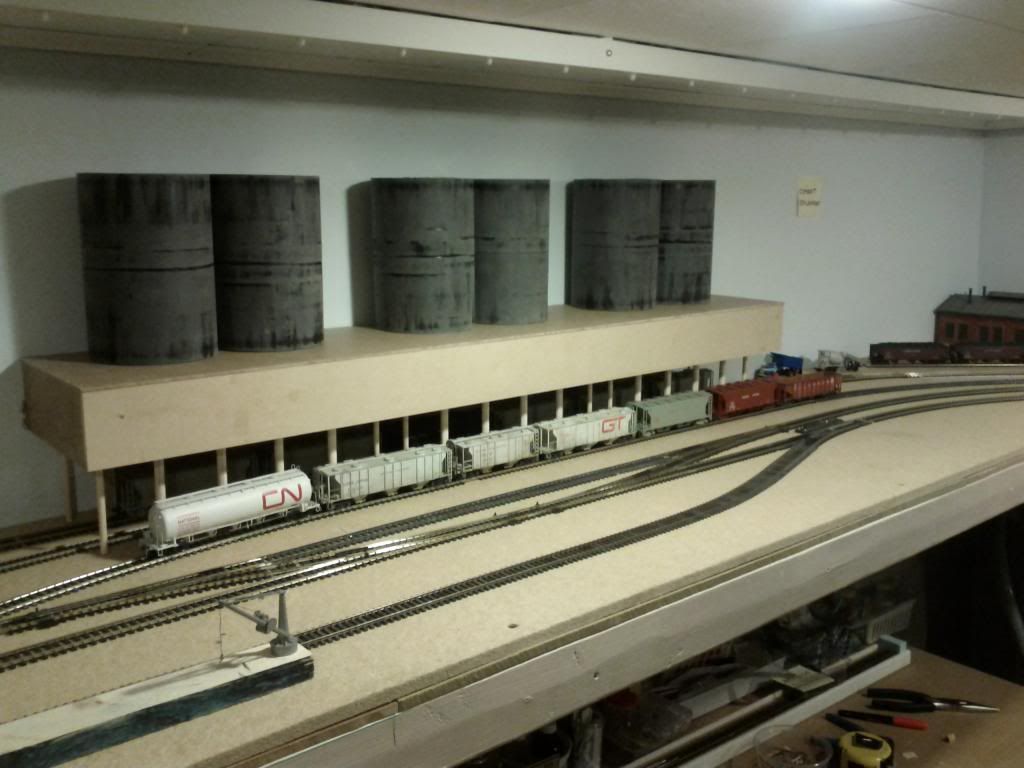
Earlier this year, a big ill-conceived cement plant found its place on the layout. Track design was realistic and well-done but the structure couldn’t fit the available space. It became quickly a parody of itself. No wonder it was dismantled as soon as it was built.

 
More than you can handle - The cement plan layout

Finally, in a recent realistic operation session, I found out switching about 30 feet of mainline was taking almost 3 hours. Enough to tire any operator I know. It was clear, we had to make room for something new and start thinking all over.
 
The savior was a small 14-miles railway in Joliette, QC called Chemin de fer de Lanaudière. Utterly minimal, it was everything but plain. Operation made sense, switching industries called for simple but interesting moves and interchange with Class I railways made it feel larger that really was. I was convinced Hedley-Junction had to disappear and quickly studied the new prototype. Soon a new streamlined layout plan was born. I can’t say my fellow club members were enthusiastic, but they recognized it had its strong points. We knew we had to do something, but we had to step aside for a while. It was decided we would take a break for model railroading, as long as needed. Talk about a smart move!

Then a few weeks ago, club resumed its activities. First of all, we evaluated the layout features coldly. Good designs would be kept as they are or improved, other unsatisfying area would be modified to suit our needs. Funny as it can be, we found out most of the layout was good enough to survive. But Hedley-Junction industrial district was identified as a real let-down in term of appeal and operation. We particularly discussed the small peninsula future. I was convinced it had to go, but Jerome and Louis-Marie had a different opinion.
My Lanaudière layout plan used it to create an interchange point with a diamond and that caught their imagination. Jerome always advocated we should represent Allenby, a busy CPR-CNR crossing in Quebec City. The peninsula was good enough to make it happens following the Lanaudière proposal. It’s no exaggeration to say this was the layout turning point. It was now possible to envision the entire rail network before us and select pertinent features over anecdotes.

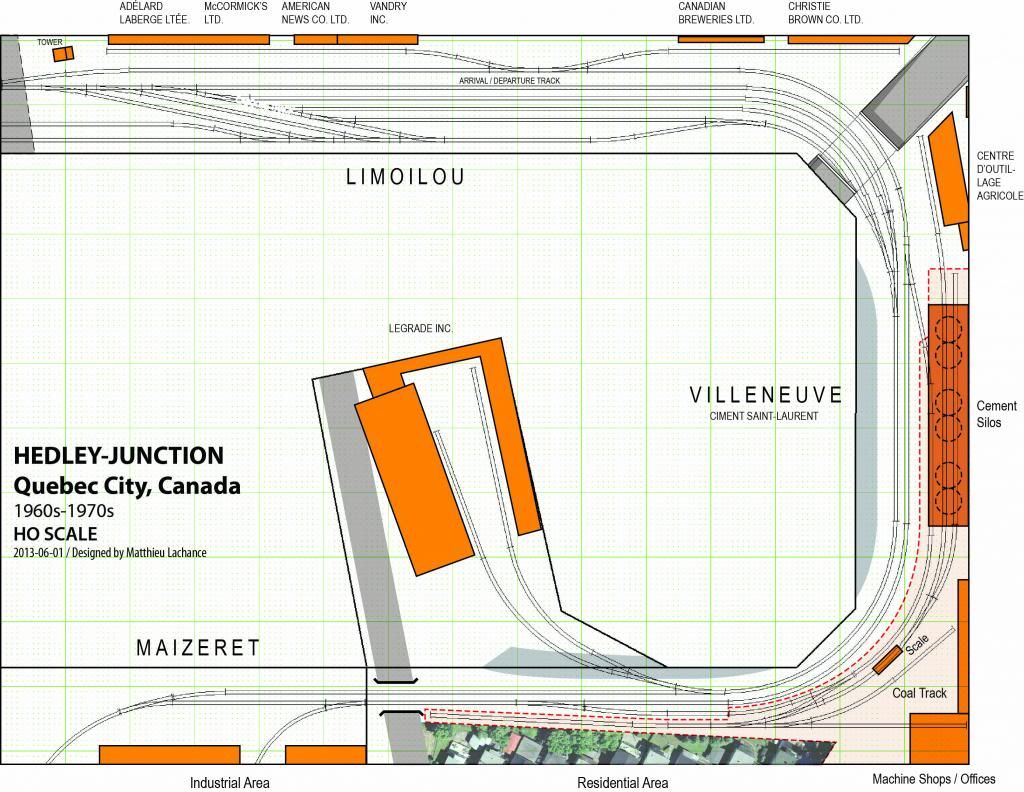
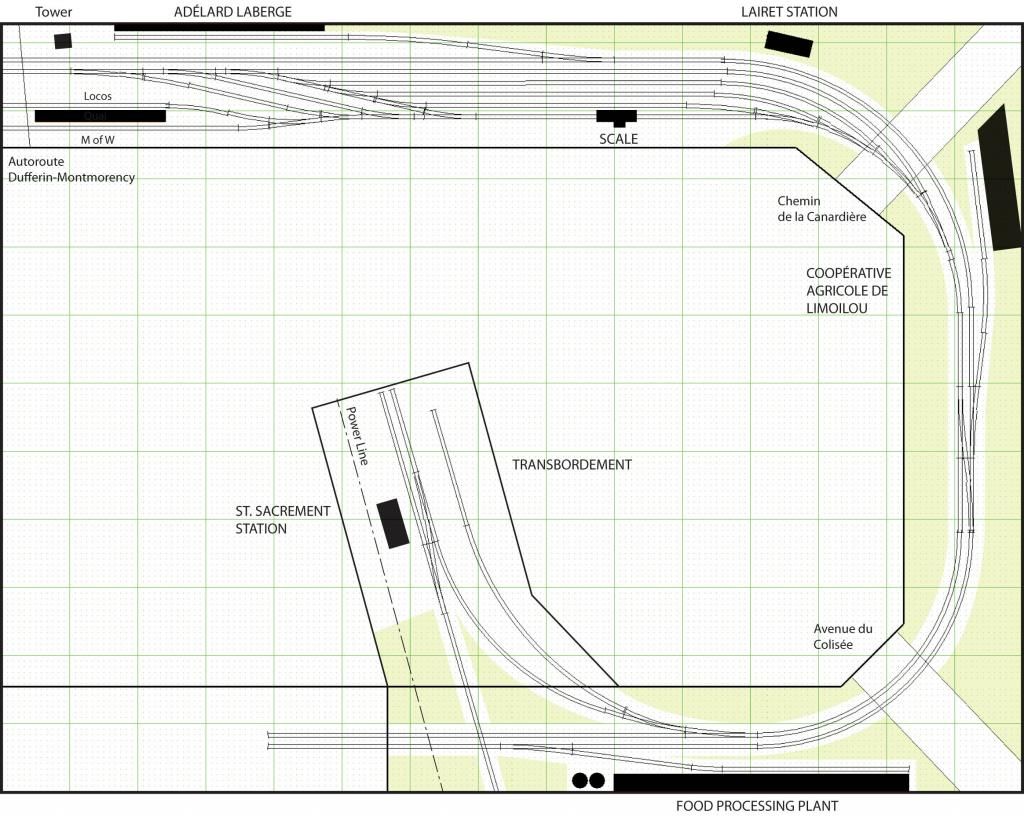
The actual updated track plan - "Less is more"

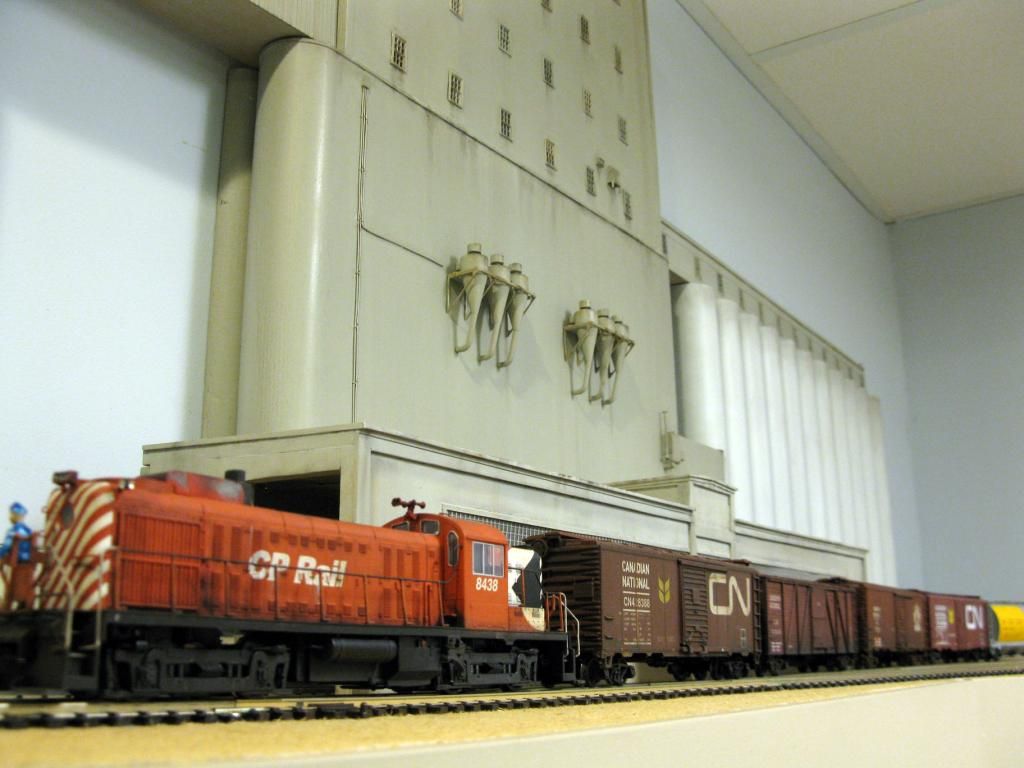
The result was a stunningly streamlined but realistic track plan. Over 50% of available area is now pure mainline running in a suburban Limoilou’s neighbourhood. Most scenery is focussed toward a realistic depiction of track roadbed and we now have a real interchange point with CPR. This gives the layout a real destination for its trains and a great photogenic spots for Multimark CP Rail MLW fleet!

BTW, track will soon be upgraded with PECO code 83 turnouts. We particularly appreciate how easy to operate PECO turnouts are. They are fairly nice to look at and no need for complicated and costly operating devices. Most turnouts on mainline will be #8. Yard will be made out of curved #7 and straight #6 turnouts. Minimal radius is 36 inches, maximum is 44 inches. Why? Because it's more realistic, but mainly because operation is easier. Having a yard on a curve can only works if you have no coupling issues. Also, I wish my U-2-g can travel again the rail without causing shorts. Anyway, with less track you have more place to use longer and better looking turnouts for smoother operation.
Seeking your state of mind

Everybody who built a layout knows at some point it is an evolving beast that follows many rational and irrational influences.

When the project started, we were stuck on the 50s and the 60s. The idea was all about diesel, steam, CNR green and yellow, CPR maroon and grey. We also thought it was the busiest and most interesting era of Quebec City, before the golden era downfall occurred in late 1959. People here like to think they had their “revolution” but one must admit the same process occurred all over North America about the same time. 60s and early 70s were all about perceived modernization and rejection of the past. Mid-70s onward marked a shift from industrialization to a tertiary sector-oriented economy were trains struggled to keep their place. All this may seems a big caricature of recent history but it helps show us how simple minded we can be when picking up our modelling era. At this point, I feel like all railroading eras are in fact great opportunities. The real deal is to find an era so rooted to our personal experience that we want to replicate it in miniature to be able to live it again.

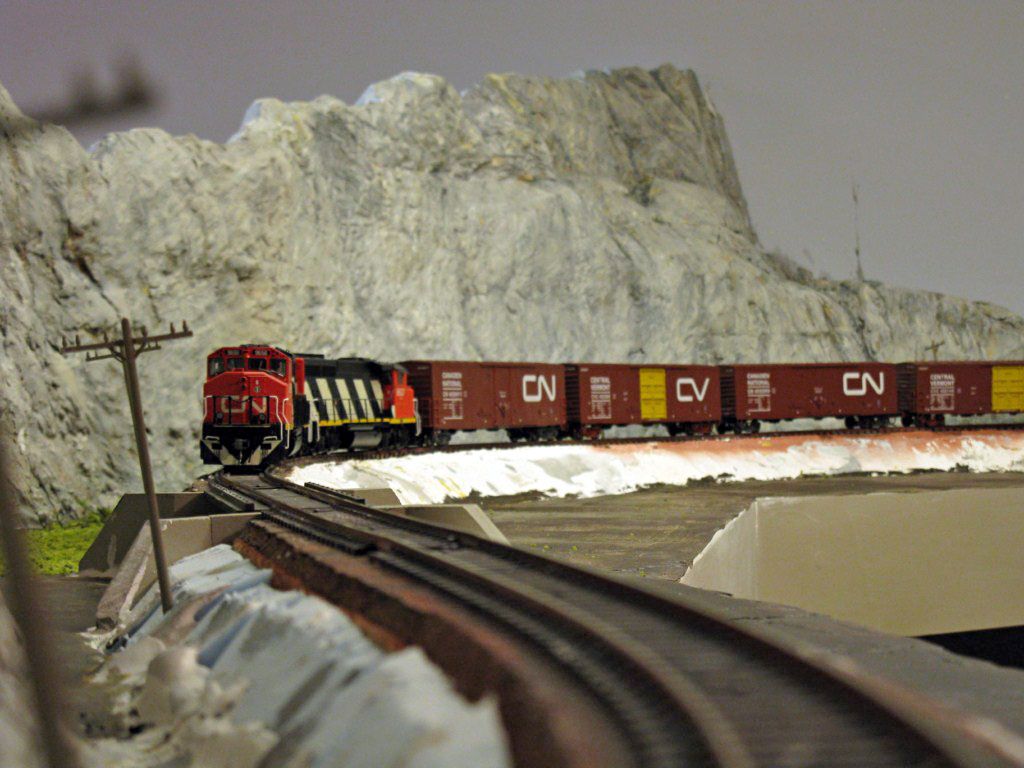
A "wet noodled" locomotive pulling a string of brown boxcars...
 
Our club story is no different. All three club members grew up discovering trains by watching CNR orange and black “wet noodled” locomotives pulling strings of brown boxcars, dirty hoppers and a guy waving the hand in the caboose . All we knew about CPR was their flashing Multimark-schemed rolling stock only seen on toy trains. Only Louis-Marie, the older of us three had faint memories of seeing regular local passenger services while a young kid.

Despite loving the 50s, we must admit we get excited every time a new Canadian prototype HO locomotive is released, especially 1960s and 1970s Alco-MLW stuff. We all love classical caboose designs such as CNR Pointe Saint-Charles and CPR Transcona. We hardly have the same feeling for late steamers. We like them, but hardly can feel the same nostalgia. Truth to be told, we never saw them in action but we witnessed MLW M420 in their glorious days. As poetic transition era can be, its memories aren’t ours. In that state of mind, it’s hard to feel totally involved into a project and more honest to just take a leap toward what made railroading such a blast when we were kids.

Many have said it about model railroading… Better stick with what inspire you and makes you feels trains are great.

Monday, December 9, 2013

Moving forward!


Some would think that switching eras, particularly moving from the 50s to the 70s, would mean a loss in charm and historic background. But when you think about it, you find out this era was thriving and full of details that make model railroading so exciting and fun...


The 1960s and 1970s were tough years for railroading in Quebec City area. At that time, important cuts affected passenger services prior to VIA Rail, including the closure of St. Raymond and Murray Bay Subs and discontinuation of service on Quebec Central. But the most drastic change was closure of historic CPR Palace Station in the wake of an ill-conceived urban renewal projects featuring highway junctions sprawling over the former transportation hub. Tracks in downtown were removed up to Cardona junction, now a simple track leading to Wolfe’s  Cove tunnel. Lack of interest about sustainable transportation, in particular railways, was underscored by the new location of Quebec City passenger terminal in a decaying WW2 industrial neighbourhood located in the middle of nowhere and not linked to bus routes. That new station’s life would be as short as can be and was quickly closed by VIA Rail. That epoch also saw the destruction of most railway structures still standing in the area, including virtually all train stations and service facilities. One could have though was definitely done over railways.

At the same time, CPR was trying to diversify its activities by implementing an important container business at Wolfe’s Cove. It didn’t last long but still was a thriving source of traffic for the time. At the same time, CPR was also fancying the idea to ferry cars to Quebec North Shore. A new pier was under construction when the deal fell through. The new ferry would be located in Matane and operated by arch-rival CNR.
Meanwhile, CNR operation in the area were still the same as the 50s, even if the downtown core businesses were closing down one after another.  Most subdivisions were intact and profitable at some extent, including textile, cement and paper industries. At this time, a decade before Ultramar built a refinery at St. Romuald, Wolfe’s Cove was covered by dozen of oil tanks were another source of recurrent rail traffic.
This era was also best characterized by many attempts by CNR and CPR to modernize their corporate image with mixed results. The colourful new schemes, side by side with older designs weathered by times, created a mosaic bringing together two worlds. It wasn’t unusual to take a glimpse at a glamorous but faded yellow and green CNR locomotive lashed up with a dramatic and contrasting orange and black engine sporting the undying “wet noodle” cleverly designed by Fleming. Later, CPR would make its own bold statement by unveiling the CP Rail era with its mind boggling Multimark logo. Ill-fated and despised by hard core followers, one must still admit it was the most coherent answer to CNR made by CPR executives since the 50s.

At the same time, car designs evolved quickly in size, specialization and shape. Iconic Canadian rolling stock like slabside hoppers, cylindrical hoppers, modern all-steel caboose were shaping a truly indigenous railway landscape. It was also the last days of large scale competition on diesel locomotive market with manufacturers such as MLW and CLC still in business. In that respect, another Canadian feature, now a staple of North American railways was introduced: the safety cab, known as the wide nose cab. Appearing on iconic locomotives such as M420 and GP40, it spread like a wildfire across the continent. Meanwhile, larger 3-axle designs were hitting the rail, including Alco Century series.
No wonder the 60s and 70s were a pivotal era of railroading, as much as the golden 50s. It was a time of modernization, rationalization and reorganization that would bring our actual understanding of a freight-oriented train world.

Monday, March 5, 2012

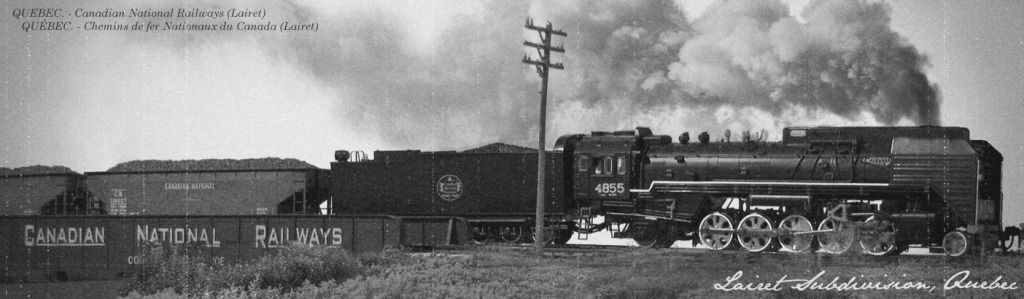
CNR 4855 on Lairet Subdivision


Archive picture showing a brand new CNR 2-10-2 #4855 pulling a coal train on Lairet Subdivision, Quebec, in September 1957.