Showing posts with label Operation. Show all posts

Monday, February 10, 2025

Ciment St-Laurent - All Tracks Done!

The layout ready to receive the new cement plant concrete pad

Another big step has been made last weekend with the installation of rails on the cement plant main building. This structure was built on a large concrete pad with embedded tracks. We wanted to keep that look so a thick slab of sealed MDF was used to replicate it. Gluing the rails wasn't an easy task and at the end of the day, they aren't as straight compared to our usual standards, but no derailment nor any running issues after an entire operating session.

Lots of depth in the yard and under the plant.

Meanwhile, we have planned the next buildings to add to the cement plant, including the laboratories and the workshop. The big furnace and coal dump will be depicted on a printed backdrop for lack of space and to better reflect how things were back in the days. The plant is so huge that modelling everything as a flat would look absolutely overpowering for such a small layout.

CN GP9RM is taking over the plant switcher for a while

On a positive note, reaching that step where ever single piece of rail is in place and working has enabled us to start running trains there for the first time for a long while. The GP9RM was doing some switching duties while the new Rapido GE 44-tonner is getting a fresh coat of paint. More on that project latter, but basically, Ciment St-Laurent had a GE 45-tonner (a modernized one). The original goal was to use a Bachmann one but it proved to lack pulling power for our long cuts of cars. Also, adding DCC, sound, a keep alive, a gyroscope and some more weight in it was a nightmare, I've seen people succeeding in doing that, but that's a lot of work. For this reason, we decided to go with a Rapido GE 44-tonner. It's far more reliable and powerful. Perfect for our needs.

The return of gypsum cars really change the operation game

With these new exciting developments, we are now thinking about bringing back the gypsum and probably the coal traffic to the cement plant. When it closed by the late 1990s, they no longer used coal. At the end of the day, we may decided to backdate the layout from time to time and I see absolutely no reason not to have the full experience when switching Villeneuve. It really adds hours of operation without changing anything else.

The bagging plant waiting its final coat of weathering


Friday, March 18, 2022

DCC Frustrations & Hopes

 In the last few months, the DCC system on Hedley-Junction started to fail... First, it was Rapido's SW1200RS locomotives acting funnily. For some weird reason, when we started using these locomotives, some issues with decoders started to appear. Other locomotives on the layout at the same time started to have serious problems. Motors acted weirdly, producing unhealthy noises, then, we loss control of them. Some would be be running perfectly forward but would run full speed at step 1 on reverse. Worst, for some, you could control the sound but they were idling, unable to move.

Then, I started to run some brand new locomotives from my collection and they would perform fine. A reset was performed on the DCC system and a few locomotives. Finally, all battery from the control cabs were replaced. It kind of worked, but we couldn't salvaged the SW1200RS which are, for the foreseeable future shelf queens until investigation kick off.


It was a really frustrating moment. Coming back from the lockdown, restarting the club meeting and feeling the mechanical aspect of the layout is crumbling apart was disheartening at best. So much efforts to reach that point wasn't fun at all. We are now embarking in a program to reset decoders, readjust each locomotives, clean and lube them. Two years of semi-hiatus wasn't great for the layout.


Also, over the last year, a strange chemical process started to attack the nickel-silver rails. Corrosion similar to rust started to pit the rail surface. Dark brown and black, these spots couldn't be removed by chemicals or polishing. A small test section polished with 320 grit sandpaper removed some spots, but they reappeared quickly. We all know sandpaper is never a solution anyway.


This corrosion creates all kind of issues with the locomotives. It's particularly problematic with sound equipped models. So far, it seems Athearn Genesis geeps are performing the best. I may be warming toward newer Athearn products to be honest. I'm not a fan of the flimsy details, but I have to admit after a two year hiatus, they are still performing brilliantly. However, most other locomotives aren't so lucky.


We've been investigating the rails using a magnifying glass and lots of micro abrasion can be seen. To be frankly honest, in the early days of the layout, our methods were coarse like many beginners and we didn't care enough for our rails. Now, we pay the price. However, the corrosion issue is strange. Temperature and humidity conditions didn't change since the early days of this layout. The spots appears everywhere, but are much more present in Villeneuve yard were a lot of ballast was glued down using powdered resin wood glue. I've wondered if this could have created a chemical reaction, but it doesn't seem to be a likely cause.


At the end of the day, fighting this corrosion is almost a lost battle as the last few months have proven. We do our best to keep track clean, but there is a limit to what we can achieve. As we speak, we have started to equip a few stubborn locomotives with keep alives. This isn't my first choice solution, but it certainly improves greatly performances by making the locomotives run flawlessly.


With these lessons learned, I know I'll take more care with rails on Monk Subdivision. Live and learn, once again!

Sunday, May 3, 2020

CN Armagh Subdivision: Exploration in Design


It won’t come to anybody’s surprise I’ve been pondering for years the ever elusive question about a home layout. In fact, this dreadful perspective has haunted me since my childhood, always struggling with old houses not designed to host any kind of decent model railway. Two years ago, I finally decided to build a hobby room acting as a future home of layout, an exhibit of my various collections and a workshop.

Via Rail Budd car at Monk Station (Credit: Jean-Pierre Dupuis, 1979)

Predating taking that big step, I wrote a series of articles titled “Thinking out loud” which was intended to freely explore various ideas without being constrained by our main project, namely Hedley-Junction. It was a terrific experiment that both helped me to better frame my interest but also explore how to size the scope of a subject so it can be turned into a real project. Various great ideas were explored, including a paper mill in East Angus which captivate me, and Temiscouata Railways among others. I also recall exploring the possibility of creating a runaround layout based on QRL&PCo later days. While these weren’t necessarily intended to be built, these designs indeed cross-pollinated Hedley-Junction in such a way it was possible to take bold actions never thought before that made the layout even better.

Many of my designs dealt with end of line scenarios. A very few ventured in continuous run territory for obvious “unrealistic” conditions thought I did dabble in this genre with Bedford and a version of QRL&PCo in Beaupré.

Armagh Station (date unknown, Facebook)

However, after building a few highly prototypical self-contained layouts such as Harlem Station and Glassine Canada, I came to a sad realization. I love to design, research and build these layouts, but at the end of the day, while they provide a satisfying endeavor in modelling, they don’t sustain my hunger for simply running trains. Operations are great, switching small industries too… but sometimes, I just feel like running a train and relaxing while I railfan it. In fact, I have no problem dealing with a point-to-point club layout, but as entertainment at home, it seems to be a different animal. I could probably say that when I’m home, 2 out of 3 times I want to “play with my trains”, I’m just in the mood for looking at my rolling stock in action.

I often wrote about my fond memories of my 4’ x 4’ twice around layout when I was a kid. Frankly speaking, it was the worst layout ever built, but the level of enjoyment has never been surpassed. That was 30 years ago, but what a fun thing it was. It was designed from my brother who – I never was able to replicate it – succeeded in compressing a 4’ x 6’ Life-Like track plan on a 4’ x 4’ using sectional track. My father, brother and sister helped to build and run the layout. And a few weeks later, for my birthday, my mom gave me two structures: a house and a transfer crane. A small siding provided to switching, which generally ended up with a derailment due to the poor slow speed performance of my pancake motor-equipped Bachmann F9 and Life-Like GP3802.


Monk coaling tower (Credit: Canada Science & Technology Museum)

I’m not delusional enough to believe one can capture back his childhood memories – which isn’t my goal – but I certainly believe it is possible to understand what made them a success. For this reason, I’ve been trying to explore another new continuous run layout for the hobby room, this time trying to reuse as much as I can my large roster of freight cars inherited from Harlem Station and from the previous Hedley Junction iteration when we were modelling the 70s and early 80s. Can you believe my fleet of kitbashed CN RS18 virtually never saw any substantial level of action? A crime… I know.

Naturally, I’d like to give a second life to this stuff which is generally in great shape. Bluntly, I’d like to have a layout where I don’t have to try to justify the existence of every single car or locomotive based on a specific online customer. This has nothing to do with the “I Want It All” mentality I regard with skepticism, but with the fact that at some point, it is meaningless to paint oneself in a corner which you can’t escape. Blending passion and historicity is a fine line to thread… and no wonder only running a local freight train can be extremely limiting.

Monk yard and it's coaling tower today (credit: Dannick Fournier)

Is it really a wise move to have all that rolling stock I still like unused because it is unfit for the local feed mill or the small paper mill? Is there a way to stay perfectly realistic will providing enough room to not condemn 80% of the collection to an unwise sale? Giving them a second life (or even just a first life) would be a sensible use of my collection and a honorable way to limit my expenses while working on stalled projects and kits.

This isn’t very different from what Mike Confalone said when he scrapped his Woodsville Terminal layout in favor of the Allagash Railway. Mike loved building this small line and its inherent charm, but he also wanted to witness large freight consists. He wanted more action and I can understand him on that point. The central question lies in how you can keep that small and realistic charm with the goal of running all kind of trains within a credible frame. Once again, it is a question of balance and the less is more approach can help us to find a way...

To be honest, this train of thought started when I built Glassine Canada. At one point, I had a drawer full of cars to test the layout and felt like many of them would never be used on any project of mine. Worst, when I started to store my collection in my cabinets, I found literally dozens of cars that were great but no longer had purpose. What could be done? Sell them? Or use them?

At that moment, it came upon me it a small layout that would replicate a diminutive classification yard would be a neat thing. Add a small engine facility and you are in business. No need for specific customer cars. I had memories of my friend’s layout during our high school days. It was your typical 4’ x 8’ layout from the 80s, ballasted with sand and dotted with kraft paper mountains. While ugly, it had a decent 4-track yard with a long enough lead to perform decent switching moves. We didn’t really know exactly what to do, but most of our fun was derived from doing classification work in that very yard, building and breaking trains. One would give instruction and the other switched the cars. Later, when we built our first club layout in 2007, the same casual switching approach was taken. And you know what? We had a lot of fun.  It was not a soulless job, but great game. With some refinement, it could have been quite great in fact.

If we go a little bit further, you could say I have great interest in simple solo operation such as switching a team track, have fun doing classification work with a friend and a great love of watching long trains running. The three actions have in common looking at freight cars and locomotives moving at a very slow pace. I’m a freight car enthusiast, what can I say!

Now, how can you put together these contradictory elements without having a mess of a layout? Well, let’s see what I designed.

A Layout Concept

Some want a dream layout… but I’d rather have a freedom layout. Something with enough versatility to sustain my eclectic needs while having a strong narrative grounded in reality. I’m not into imagineering stuff thought I certainly do admire those able to find their creative way!


Before moving forward, let’s put some conditions. First, the layout must be generic enough to fit a few decades without looking anachronistic. Given my rolling stock collection covers well the era defined between 1952 and 1981, that gives us a rough template where to look for a prototype. The said prototype will be a little bit backwater to explain why it didn’t evolve over the years. Fortunately, such places did exist and they were in fact numerous on our continent. Next, we will need a main line, a yard and maybe a small town to perform a few switching moves. Adding an engine terminal to simulate a division point where locomotives are maintained and turned would be also a great idea. Don’t forget a roundhouse, with its supply track, is indeed an industry in itself and not just a magnified locomotive parking lot.

Monk yard (credit: unknown, 1973)
The mainline will provide the excuse for running and railfanning anything that fit the chosen era, be it large locomotives, multiple unit consist or passenger trains. Let’s be clear, if the layout is set in the mid-60s, what is running that day will be consistent to the era. The yard will provide classification work to build the local trains while the small town a reason to run the aforementioned local freight trains for short yet rewarding switching sessions that would last anywhere between 20 minutes to 1 hour.

Also, these tree aspects shouldn’t contradict themselves but rather complement each other. By example, if you are working the yard, it should be possible to let a train run on the main line or having a friend handling the local freight. It should even be possible to stage meets between opposing direction trains.

As for a prototype, it seems to me CN (ex-NTR) Armagh Subdivision (also known later as Monk Subdivision) on Quebec South Shore would be a neat place to draw inspiration from. It was abandoned in 1981, saw a sustain level of traffic to the Atlantic and hosted a few interesting rural villages. Local customers were related to agriculture product/feed, lumber, pulpwood, oil and coal. All things I love on a layout. Better, Monk itself was a division point with a roundhouse where crew change occurred. It hosted a large two-storey station and a classification yard full of weeds and bushes, making it a very scenic place with a sense of remoteness and abandonment.

Monk yard (credit: unknown, 1973)

Monk Subdivision also saw passenger traffic between Charny and the Maritimes. It also had a cool mixed freight train in the 60s and railiners in the 70s. Better, all the old wooden structures survived up until the line close in 1981. Since that subdivision slowly faded away starting the end of WW2, it seems CN never cared to “improve” all the buildings with cheap grey shingle sidings and sky blue/orange doors. Basically, they still looked like they used to in the 1950s with their dark red siding and cream trims. In fact, judging how bad the paint looked on color pictures, I guess they never cared to repaint them after 1960.

But better, if you remember my Quebec South Shore Railway project with the small feed mill, you will also recall it was originally located in St-Pamphile, on the Quebec Central Lac-Frontière line. I even mentioned in my fictional story that the feed mill siding handled lumber and cement for the restoration of a local hydroelectric plant. Well, near St-Pamphile is the town of Armagh on Monk Subdivision which had a small siding for a feed mill that also loaded lumber and was located less than a kilometer from a hydroelectric dam. Seriously, if this isn’t a great coincidence, I don’t know what it is. Also, Armagh had two stations. The main station sported a depot, a passing track and a very long team track handling all kind of goods including coal and oil. You could also find a water tower and a section house with a speeder shed. About a mile further East was Langlois Siding, a small flag stop which had only one siding serving the aforementioned feed mill and a portable station. Within the same locality was a quite large deck bridge over Rivière du Pin valley which provided quite a spectacular and scenic panorama.

So basically, a Monk Subdivision layout would feature a lightweight version of Monk yard, engine facilities and station in a realistic manner and a small town similar to Armagh with both station and the large bridge for the sake of coolness.

Lacasse feed mill, Armagh (credit: Ministère de la Culture du Québec)

Generally speaking, when designing, I like to have access to prototype track plans. In the case of this layout, I thought knowing less would be better. I’m not that much interested in modelling the exact prototype, but I do like its flavor. Monk was created weeks before I had access to a map of the area. Only pictures helped me to shape the various scenes in a more artistic approach. However, I must stress my knowledge of how railways work did help a lot in creating something grounded in reality. Not following a specific prototype wasn’t a reason for doing fanciful interpretations.

In terms of trackage, only the strict minimum is required. In that regard, I based my design on Craig Bisgeier’s excellent Ten Commandments of Model Railroad Yard Design and Trevor Marshall original design for Fresno Yard on Pierre Oliver’s excellent Clovis Branch layout. The engine facility is based on Marty McGuirk’s The Model Railroader's Guide to Locomotive Servicing Terminals book, but also on Rick de Candido’s exquisite Fillmore Avenue Roundhouse layout which, when his blog was online, used to be one of the most interesting source about steam engine facilities. Also, the beautiful CPR Orangeville, ON roundhouse also provided a lot of inspiration.

So basically, I provided for a long passing track to stage meets but also to act as an arrival/departure track. A caboose track, in front of the station but behind the yard provide for an interesting visual element to stage. The yard can be operated independently due to its long yard lead.

Langlois Siding portable station (credit: Ministère de la Culture du Québec)

The engine facility is small, yet most elements are there. The inbound track is equipped with an inspection pit, a coaling tower, a sand house and an ash pit. A long supplies track act as a customer and will also serve a few diesel reservoirs. I’ll have to decide where the diesel fueling pad will go, but it will probably be on the outbound track. Monk roundhouse used to be quite large, but by the mid-1950s, it was abandoned and used as a saw mill. According to a map from the era, it was by then a 6-stall building, which could be easily replicated on the layout. The rest of the track plan is simple and self-explanatory.

This layout plan has been an exercise in restraint. It could have been easy to add to much stuff and in many cases, I removed tracks and structures to keep the scenes uncluttered and turnout count as low as possible without compromising the operational aspect. At this point, 14 turnouts would be the maximum required, which, honestly, is quite low given the scope of the project.

However, do I consider it visually balanced or even interesting? Could it work in my room without overwhelming the place? These are good question. The bridge scene, Armagh and Langlois Siding would be nested under 15” deep display cabinets while Monk Yard wouldn’t have any valence over it.

Rivière du Pin bridge, Armagh (credit: Dannick Fournier)

I believe having the yard as the focal point when entering the room is probably the most compelling way to present the layout. Not only is it the main component, but it is also the anchor to the various stories that can be told.

The second focal point would be the bridge scene. With a total span of 39”, this is a major visual component that creates a sense of distance while providing a majestic setup to show case locomotives and rolling stock. Then, the last major element that one could only see when entering the room would be Armagh, confirming the second role of this scene and stressing its inherent rural nature.  The final scene would be Langlois Siding which can be a little bit tricky to execute. One could be tempted to consider it a separate scene, however, the physical distance is almost inexistent. In my mind, it should be considered as a geographical location merged with Monk Yard. It isn’t unusual to have customers located within the yard limits and I feel it would be the best bet.

Will I dare to build a version of this design? I don’t know, but it is an interesting option to explore given the flexibility in term of rolling stock and how it repurposes a huge chunk of my collection. It is also an assessment about my interests in this hobby and how I relate to models.


Thursday, February 6, 2020

Guilty Pleasure Layout Planning

Over the last couple of weeks I had a few discussions with fellow railfan André-Pierre Savard. He is your typical HO scale collector that buy a few brass locomotives, try to assemble  a fleet based on his nostalgia as a kid growing up by CN mainline in Quebec City and who don't model nor will ever build a layout on his own. I know, I'm painting him in black, but be assured he's the kind to like to be teased about his armchair modelling.

That said, André-Pierre has visited many layout and ran trains on them. Probably about 100 times much more than I did and I'm not exaggerating. Most people would be surprised, but I rarely visit or operate on others layouts. Interestingly enough, André-Pierre has come to the same realization that model railroading is a matter of "less is more" even without living the frustration of building a layout. Many people have great skills, but a lot are lost when it is time to select only a few idea. More than often, the "I want it all" mentality simply crushes their good intentions and skills.

Naturally, our discussion wandered on the subject of the layout in my new hobby room. As I told him, I had many ideas, but nothing very serious in mind. We convened the best choice would probably to keep thing generic and simple. In André-Pierre's words, "a team track is more than enough". He loves well made scenery, single track mainline and as little turnout as possible. I can agree with that. So I sent him a track plan I drawn a few years ago based on Erie Railroad's Dayton Branch near Springfield, OH. The exact location is where Maitland Interlocking tower was standing not so long ago.

Original "Erie-based" layout plan (2018)


As I told him, the location is irrelevant. I only found it visually appealing, "railroady" enough to make my modeller's blood happy and in fact, quite simple. He found it quite interesting, noticing that it could even be simplified quite a bit which I did today.

I'll be honest, I tried a lot of things for this prospective layout and I'm always back to Dayton Branch. I don't know why, but I feel this place is quite universal in its appeal and capture the essence of North American railroading as I like it. I would call it a "guilty pleasure layout" because it's a no brainer.

Revised track plan

However, it doesn't mean it is a stupid idea. Far from it. The focus is given to a single mainline track running through fields and woods. Only one large customer is there and cleverly located near a junction, which would be indeed a wise decision for a business.

Another reason why I call it a guilty pleasure layout is because you can railfan your trains on such a layout. A neat mainline run is always the best way to display your trains. You want a small steam mixed freight? You can do it. You want a 5-locomotive consist pulling 20 cars, you can do it. Canadian National, Canadian Pacific, Erie, Maine Central, why not? The track plan is so simple and generic it fits all scenarios. And don't believe this is laziness. In fact, it is more honest, I think, than taking a prototype you like then trying to shove something here and something there.

Not only you can ran any trains, but you can also replace the industry with something else. The footprint is versatile enough to model various structure you can replace. A feed mill, a manufacturing plant, a food processor... anything goes on. Even the tower can be replaced with different prototypes depending on era and railway.

I could add more things, but it is enough to make a point. It is enough to correctly model railway operation. Is it more than enough to care about details, track details, topography details, vegetation details... Insignificant stuff that makes a railroad real.

This is also the kind of layout that can evolve with you. You can replace structure and scenery as you get better. It is also possible to use all your rolling stock and motive power as you wish. Modelling a perfect prototype is an interesting process, but in all honestly, I like that simple vibe. You know, when you can sit in your armchair, look at your trains running by, as if you were standing at a nearby grade crossing and enjoying the moment. Which, incidently, can only reminds me of Mike Cougill's words in his most recent ebook "The Modeling Conversation", reflecting on his evolutive relation with his craft. Far from giving a recipe for success, Mike has once again touched that sensible subject: finding solace in your hobby should be of great importance... whatever the shape it takes, as long as you realize it is the one that fulfills you. To me something is missing, and I know it is being a spectator of trains... maybe it's why I often have more fun watching Jérôme operate on the Murray Bay subdivision than when I'm controlling the trains.

Sunday, August 25, 2019

JMRI Operation In Action


Over the last week, work on the layout came to a halt. Not due to lack of interest, time or resources, but rather to enjoy actually running trains, troubleshooting the track work once more before scenery is applied and to gauge how our JMRI Operation programming perform.

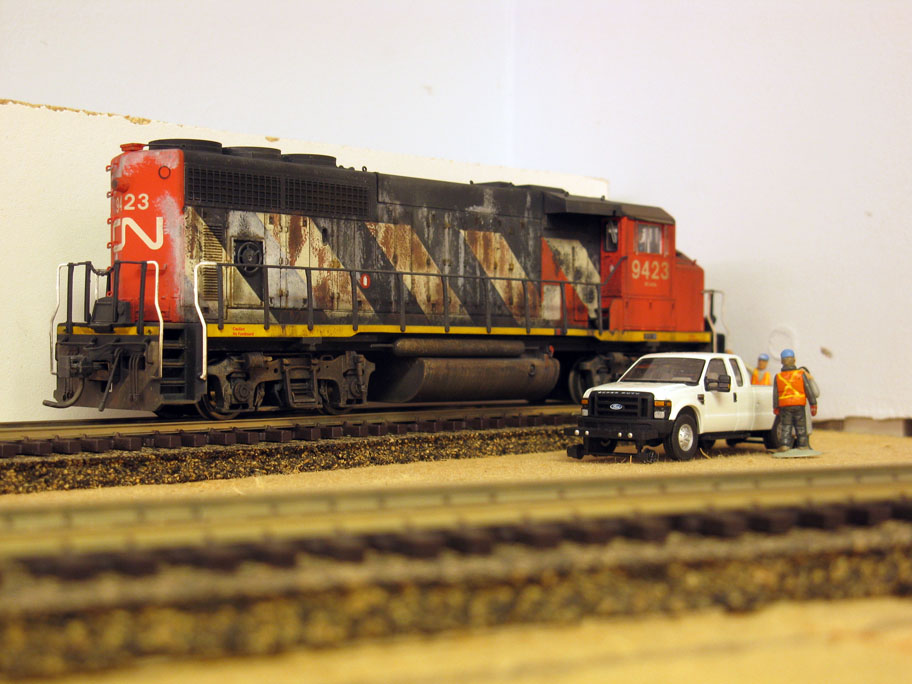
Leased CN 9423 switching a cut of empty cement cars at Villeneuve

So far, intense rail polishing over the layout help to greatly reduce electrical issues. At this point, I’m confident to say 95% of the rails are perfectly clean, which greatly improved operation. We simply use a 1” x 2” MDF block with 220 grit sandpaper firmly glued on it. It does a great job and keeping one at hand helped to track down issues without wasting time cleaning all the track at once.

In term of locomotive, my Atlas GP40-2 CN 9423 is now fully operational. It was weathered and got a decoder a few months ago, but we finally programmed it and wired back the ditch lights. So far, this locomotive performs beautifully and smoothly. The sound is a little bit low and will need tweaking. I wouldn’t be surprised I’ll have to improve the speakers in the future, but so far, it’s quite satisfying to operate with an actual locomotive that visited the Murray Bay Subdivision at that time.

As for JMRI Operation, we had a rickety start because I fiddled too much with cars which caused errors. Besides that, we found out I over complicated how Clermont and Villeneuve yard works. In general it is fine; however some cars have weird and erratic movements that don’t fit their normal behavior. It seems I’ll have to reprogram some tracks and routes to make sure car flow is more fluid in the future.

I could reprogram everything now, but I prefer to run JMRI Operation as it is right now to track down more bugs.

These operation sessions were also a good excuse to get rid of many cars no longer fitting the prototype era. Several older kaolin tank cars and insulated boxcars were removed as a result. Jérôme also share my opinion several of our cars will benefit detail upgrades. It has been decided that every blue box era covered hopper on the layout will now receive the Tichy ladder rungs treatment. It shouldn’t take too long to do.

Sunday, July 28, 2019

Derail Madness

Derails are probably one of the most interesting operating detail to add to tracks. Not only they look good but they do indeed makes operation more interesting by creating a track hierarchy. Indeed you can no longer roam freely the rails as if nothing really mattered. Some point of access are controlled and no longer the siding can be considered like a defacto extra mainline track.


In our case, we used GLX 3D printed parts. While very nice out of the bag, these details require a lot of work before working correctly. This is mainly due to various dimensional discrepancies, including how the derail itself doesn't clear the rail trucks when opened (requiring carving the 3D printed ties). Another problem is the ties are quite short and looks a little bit out of place when used with standard code 83 flex track. While not a bad product, I would hardly consider it a drop in detail and can't recommend it except if you are ready to invest a few hours making them working well. If you succeed, then they are indeed beautiful and works like the prototype. I hope GLX will improve its design in the future because this is definitely a neat detail on a layout.


From the scenic point of view, I painted the detail in faded yellow. While generally I favour acrylics, this time I used enamels due to their higher resistance to abrasion. These are working details that will be handled a lot, so better use more resistant paint. I mixed flat white and flat yellow to get a sun-faded look typical on the prototype. Later, when weathering the rails, a light wash will be applied to make the details pop and add a touch of grease and rust.

Sunday, April 28, 2019

Brompton Paper - Breaking Down Operations

I recently revisited my old idea of modelling an entire prototypical mill on a 12" wide shelf recently. While I addressed the track plan, scenery and concept, I didn't venture as far as depicting operations. Meanwhile, I've read some articles about Quebec Central and discovered interesting tidbits of information that makes this layout much more than a small industrial switching layout with a typical scenic staging area.

First, Quebec Central did use to serve this paper mill. It seems there was no industrial switcher working the plant and QC trains en route to Sherbrooke had to do it.

Second, most paper products were shipped via Sherbrooke while some chemicals came from that same direction.


Third, raw supplies including woodchip and other products came from QC interland beyond St- Georges.

Put together, these elements means the staging area is no longer a soulless and practical area, but rather participate to the story. At the beginning of an operation session, some cars would be left on the siding. These would have been dropped by the train coming from Sherbrooke. Typically, we could assume some chemical tank cars, covered hoppers, empty newsprint boxcars and possibly woodpulp. On the mainline would be staged a train coming from QC interland (Vallée-Jonction). This train would have a new supplies and many woodchip boxcars.

Now, our train would have to build a short consist with all inbound cars for Brompton Paper, then move down the spur and switching empties and loads. On the return trip, cars would have to be sorted on the siding according to their final destination. Then, the session would end when the train would be ready to leave East Angus.

Nothing complicated, but enough to model the entire job without compromise.

Finally, the last point would be to decide if the track would be level or if this layout could benefit having a grade between both the paper mill and the interchange. In real life, there was a somewhat steep grade between them. I suspect it could be an interesting challenge if not overdone and a good occasion to put LokSound Full Throttle capabilities into action. But this is the kind of stuff that can quickly become annoying in the long run.

Monday, April 22, 2019

Brompton Paper - Revisiting a Layout Concept

As you can guess, Easter holidays have been spent wasting time designing track plans that will never be built. It seams I can escape that fate and will revisit my designs until the end of time!

Joke aside, I thought about refining the last track plan I made of Brompton Paper. As you, this is a small (yet prototypical) paper mill served by only a handful of switches facing the same direction. This is as basic as can be yet, quite interesting. I know from experience operating doing on the club layout that you don't need that much. Also, since we reworked Clermont yard, it has been quite clear the idea of shuffling cars between an interchange point on the railway and the plant is quite an interesting move.


Last time I put any effort on Brompton Paper, I did a mistake by making the track plan far more complicated than it needed to be. Fear got the best of me... I thought it would be a pre-requisite to have a runaround, which doubled the number of turnouts. However, I liked the idea back then that I should have the interchange modelled. It was now time to see if I could streamline the concept in such a way it would fit a very narrow shelf (no more than 12") along the walls of my new hobby room. Also, a key element was that I didn't want any cassette and hidden staging.

So here we are with the new version. The plant is now quite simpler and closer to prototype. I also placed the large steel bridge over St. Francis river where it should have been from the start. Then, a very narrow shelf (not more than 12") link the plant toward the interchange on Quebec Central mainline in East Angus. Since I don't need to turn locomotive around the train, I saved a few turnouts and was able to replicate a real functioning interchange yard based on the prototype. A few small structures including the dilapidated passenger depot gives a sense of place. The team track is there for the show, mainly to let a few cars rot there as background decoration.


However, what I like is exactly the lack of stuff. Between the plant and the interchange, there is nothing to notice. A mundane power line, a minimalist rock cut and a sweeping curve as the branchline connect with the main. I imagine a lot of wooden area, wild grasses, bushes and electric poles. Also, the distance between both location is realistic, about 1800 feet in "real" life. This is the kind of distance often seen on prototypes to reach a plant. Also, the way the layout is arranged in a U-shape makes it easy to feel we are indeed going on the other side of the river to reach a customer.

Worth mentioning is the possibility to only build the mill side of the layout. It would be fully operational without problem. The other part is mainly to give a purpose and a sense of going somewhere.


Thursday, February 21, 2019

Wyeland: a Tale of Two Turnouts


CN 9423 waiting for its crew at Wieland

Some more fine tuning in Wieland last week and that’s fine with me. Drawing a concept on a sheet of paper and explaining the thought process on a blog is a part of the journey. Shaping it with materials, in 3D and bringing it to life is another. Both process are concomitant and not simultaneously exclusive. As happen too often, the best intentions don’t always bring the best results. However, it is ours to witness what happens then take action bring back the balance between intentions and results.

I often remarked how implementing a working concept on the peninsula wasn’t that easy to tackle over the last few years. This observation is still hold true and I’m still figuring out a way to make the best out of the situation. Fortunately, while the geometry is somewhat ingrate, the goals are becoming clearer. It is always easier to struggle with an issue when at least you know where you want to go.

Our layout will never be much more than an elusive suggestion of railroading in Charlevoix. It would be completely foolish to believe we can replicate the subdivision. However, getting the sense of the place right is something that we can do. It is why I had to make some compromise on the track plan to better reflect our needs and aspirations.

After operating the upgraded track plans for months since September, it became quite clear we eliminated too much trackage during the revision. Was it a mistake? Were we foolish in doing so? It could be easy to affirm we went a bridge to far with theoretical concepts. Maybe it was wrong to apply a less is more approach in such a drastic way.

In fact, the answer is no. With limited resources and space, you’ve got to make the exercise of identifying the bare minimum that defines the project. Taking out the clutter was the only way to remove the noise from the signal. It is also the best way to understand what specifically represents your subject and what is merely background decoration. It’s all about defining the essence of a project. Maybe we went a little bit overboard, but not that much if you ask me. It must be noted the new track plan works wonderfully as intended and the small glitches are… small glitches.

It would be foolish to think you can tackle a complex topic and find a perfect solution from thin air. Adjustments are required and we are now working our way out. Given our biggest shortcoming was removing a leg from the wye, we can already say we were definitely quite close from our goal.

Now, you will ask me why we made that mistake. The reason is quite simple; we tried to figure out what was required to operate all aspect of Clermont without cramming too much elements. If something was redundant, it was eliminated after seriously taking into account how it would impact freight car movements. In a nutshell, our track plan worked nicely as a representation of freight operations on a shortline. However, it failed to provide an answer to locomotive management. At first, it was thought parking locomotives on a yard siding would provide an efficient solution. Unfortunately, it was in conflict with freight movement and left our story unsatisfying.

As you know, I often like to compare a layout with a story. Train operations require a starting point and an ending point. Basically, you need an introduction and a conclusion to your story to make it meaningful. In some case, these things will be minimal… the train was already there when we catch up with the story. Sometimes, it is quite simple. In another case, a more complex introduction and conclusion is required to better understand the story finer aspects.

With Clermont, it was clear we missed some point. In our story, the yard isn’t the introduction nor the conclusion. It is in fact the space where the narrative is developed. The fact the locomotives originated from somewhere else and reached the yard after a while was part of the story. It underlined the typical nature of branchline railroading. It was the only way to make it clear the paper mill is a destination you need to reach to perform a task and not simply a vague place where train movements can happen anywhere.

In that regard, what we sorely missed was the importance of that step. We overlooked it and it came back in our faces each time we operated the layout. Leaving carefully detailed and weathered locomotives in the middle of nowhere didn’t make sense and made for an uninteresting conclusion. However, I must point out many mockups were made in the past. Based on these experiments, we came to the conclusion a locomotive shop track wasn’t required and would look contrived. As the project progressed, our fears went unsubstantiated and the issues raised by the lack of track became more and more evident.

Now, what is this track all about? It was simply a wye leg that we didn’t replicate. If you ask me today, I would tell you it was foolish to model a wye with only a leg. Back then, it made sense because this wye was seldom used to turn locomotives or cars. Its basic function wasn’t required, thus a single siding was enough. Unfortunately, its other function was locomotive storage, which was incompatible with the siding role. You couldn’t merge together both function and call it a day.

The new wye leg at left with a locomotive sitting idle.

Now, on the aesthetic side of things, representing a wye with one leg won’t cut it. Visually, it was hard to believe this single siding represented a wye at all. It looked weird and incomplete. The place is called Wieland, you expect a wye… and you’ve got not enough compelling clues to believe there is one. From a story telling perspective, it was quite a fail I must admit. From a scenery perspective, it always was making it a little bit hard to create a seamless transition between the yard and the wye. One is in the woods, the other one in a light industrial setting. Something was missing to link them in a satisfying manner…


Now, this has been taken care of and the missing wye leg is now back on the layout. To be noted, the unsightly drain pipe was routed somewhere else in the room to facilitate scenery work. A grade crossing located near the new turnout will ease the transition between the light industrial park and the wooden area, just like on the prototype. While I not that much eager to add too much scenic elements in Wieland, it seems this one will definitely help in visually separating different functions and settings while providing a visual anchor in the scene. I’ve yet to figure out how this will work in 3D, but I’m quite confident it should be fine and not look contrived.

After all that said, I'm slowly coming to the realization that following a prototype or implementing drastic measures is a required step in the process, but definitely not a goal. It should be seen as a tool to analyze our subject. But at the end of the day, the artistic touch and interpretation about what we truly want to convey must prevail. The more you stick to the prototype, the more you struggle. The more you personally know the real place, the harder it becomes to make bold artistic choice. It is a double edged sword.  Working on my capacity to evoke the sense of place instead of replicating a lifeless copy of a prototype is a worthy yet capricious road to take.