Friday, April 15, 2016

Signs... Lots of Signs

When I visited Modèle B.T. last weekend, I purchase a few railway signs made by a small one-person company called in S.T.T. and based in Quebec. All I know is that the company makes limited batches based on demand and mainly sell through Modèle B.T. in Drummondville. I’m not aware of any other outlets.
 
Clermont's grade crossing protected with typical Canadian-style crossbucks.


Quality-wise, the product is top notch and made of sturdy metal, which make them strong enough to sustain layout usage while still looking good. The guy making them took great care to design them and all signs follow prototypical practices found in Canada, including the iconic red and white Canadian crossbucks. Road signs are also available and follow M.T.Q. (Ministère des Transport du Québec) practices, making it useful for people modelling Quebec. To some extent, many of the signs could be used for other Canadian provinces without problem.

A very old French Canadian crossbuck surviving at Dominion Textile.

 The signs are interesting because they follow the prototypical practices of Canadian National and Canadian Pacific from the late 60s to now. They can fit a lots of Canadian-themed layout over a 50 years period.

Just like the prototype... forbidden access to Donohue's bridge.

The downside is their price which can be quite steep if you want to populate a large layout.  It varies from less than 2$ up to 5$ depending the sign complexity and size. Smaller signs are sold in 2 and 4-packs. But that said, one should keep in mind they are craftman limited productions. And seriously, instead of buying yet another useless 30-40$ car, I suspect it is a better investment in the end with a better play value is you like when things look and work like the prototype.

 
Signs are small, but they have a great impact on a scene.

Sure, one can scratchbuild his own signs – which I would do if I had more time – but I felt it wasn’t a bad idea to support a local guy trying to do something special for the train community. Also, the possibility to make special orders seems to be possible, which makes it even more interesting for custom projects (station name signs, etc.).

Whistle posts signaling D'Estimauville Avenue.

So far, I thought I bought about 50% of required signs. But just like trees, a layout can absorb a lot of them. Jérôme installed a few of them in key location and the result is quite good. We will probably order more in a near future.

Finally, Jérôme added a custom made derail for the propane dealer siding in Clermont. All sidings in Clermont are protected by such devices. His prototype isn't that great, but there's place for improvement.  Also, Louis-Marie started working on infrared detecting units for our grade crossing. He figured out how to make a decent system with an Arduino board. Don't ask me the details, I'm illeterate in electronics, but from what I heard, it will do the same thing as higher end commercial systems but at a fraction of the price. So far, the mockup works nicely, so I'm pretty sure this is going to be an amazing achievement on the layout.

On a side note, I started working on scenery, particularly at Donohue and D'Estimauville. Stay tuned!

Saturday, April 9, 2016

A Trip to the not so local Hobby Shop


As many of you know, I altogether stopped to purchase anything you since a few months. I consider buying more cars, locomotives and structures is an utter waste of money and fun. Not that I won't ever buy any of them, but rather that it will happen only on a per case method for replacing obsolete things with more prototypical ones. Since there isn't that much unprototypical cars running on the layout, I see no need to get more. As for locomotives, I'll only purchase 2 to 3 sound-equipped MLW M420s when Rapido will finally see the light! Oh yeah, count on me for driving this into our poor Jason's mind!

But there's a more deep reasoning behing that. I remember reading many years ago a post by Trevor Marshall - or maybe someone else even if I think Trevor would agree anyway - that modellers don't think twice to compulsively buy any piece of rolling stock that catches their fancy but will cringe a lot before investing in scenic materials. Well, I took the advice and after a few months of spending nothing, I had enough cash to dare to visit some hobby shop and spend money on grass, turf, leaves, weeds and tree armatures.

A few friends well into wargaming were driving to Montreal to visit some hobby shop there so I decided to take the ride too. I didn't expect to find a lot and was kind of disappointed after I only found very few useful items. Mainly dozens of ready made ridiculous trees. Anyway, there was a few relevant supplies.

On the return trip, I decided to stop by Jeff Boudreau's shop in Drummondville: Modèles BT. I'm not here to do any advertisement, but the experience is always interesting there. The shop is very small, but the range of product is wide and pertinent to most decicated modellers. I'm not in quantity, but into quality and selection. Also, I love how the staff there is kind, polite and full of helpful advices, somewhat a rarity in a few local stores.
 
Another good thing at Jeff's shop was the chance to meet fellow railfan and railroader Mathieu Gosselin who was purchasing some neat Vermont Railway GP locomotives. Don't ask me why he is investing in a VR fleet, he wasn't able to answer to that question himself. But I guess it caught its fancy and I won't blame him for it! Reminds me the days I was buying to much locomotives for my own good. M630C? Why not isn't it?

Finally, I also decided to invest in some prototypical canadian railway signs. Jeff is the exclusive dealer for some very neat product made by a talented guy. A little bit pricey, but definitely top notch. I started to nitpick the crossbuck dimension and Jeff decided to make it clear it was accurate. He measured a real crossbuck in the backstore and we compared it to the HO scale rendition: perfect. So I bought enough crossbuck for 3 grade crossings, several whistle posts, flanger signs and derail signs. I'll probably order much more in the future as needed.

I could make my own signs, but I'll be honest, it takes a lot of time I actually don't have. I prefer to put my time on scenery, structures, tracks and rolling stock. Life is finite and I decided I could pay for this and make more progress on more significant projects. Speaking of which, I now have absolutely no reason to postpone scenery work!

And maybe I'll bite my tongue by the end of the year, but I expect Donohue and Rivière Malbaie to be fully scenicked by Christmas!

And don't forget, if MLW M420 should be a staple on your layout or you just like the prototype, don't forget to pester Rapido and Jason about doing it! We have waited for too long!

Bachmann ACF Centerflow Hopper Kitbash - Part 2

Let's continue with this bash.

After applying the first coat of primer, I quickly found out I forgot to add some brake details. A set of Accurail details probided most parts required.


I also added a chain to the brake wheel housing to make it more plausible. Fortunately, I had some spare part in the junk box. I was also a good occasion to add end platforms made by Intermountain. Subtle, but truly makes a difference.


Finally, weld seams were made using white acrylic paint and masking tape. You probably remember I did a similar trick with my Athearn Centerflow hopper kitbashes. It was OK, but I felt the results was a little bit rough and coarse. With paint, you have more control and the finish is closer to a prototypical welded seam than CA glue.


And the coat of grey paint.


And the decals.


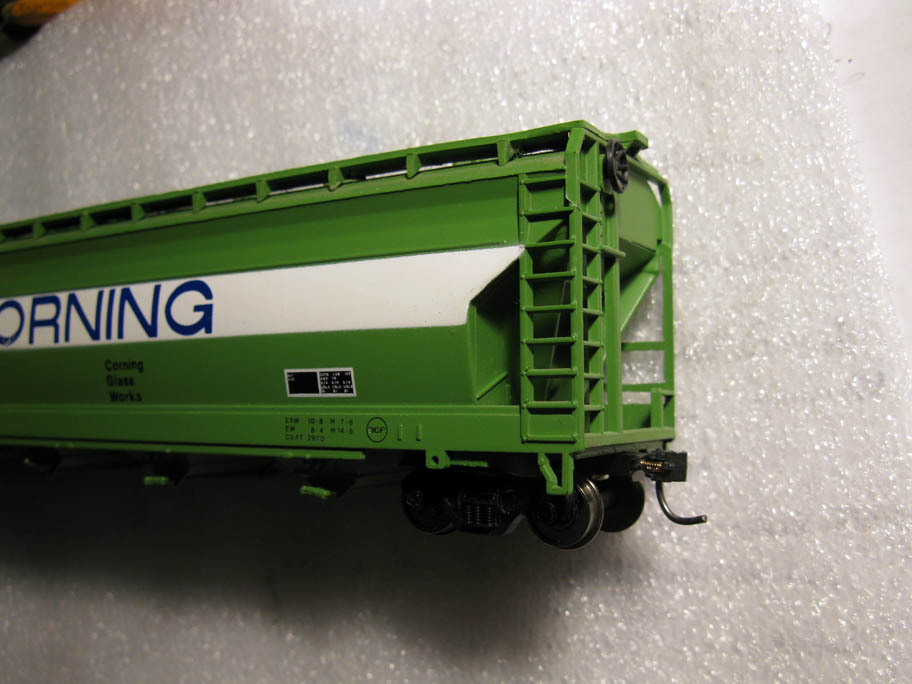
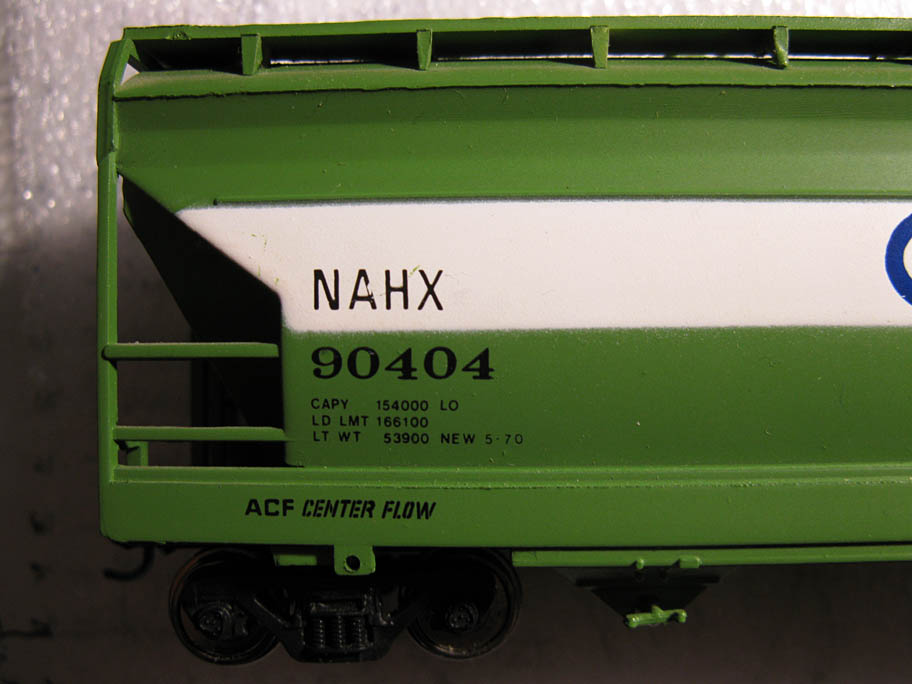
And back in the original Bachman box! Looks almost like an official release!


And while in service on the layout at Clermont. Another enjoyable small project that improved my skills. I'll will be even better with a light coat of weathering.


Friday, April 8, 2016

Bachmann ACF Centerflow Hopper Kitbash - Part 1


As promised, here's my newest project which turns out to be a complete fooby. I tried to follow Islington Station Decals instructions, but couldn't find any suitable propotype. The decals are made for a 3-bay car, but the ACFX corresponding cars have 4 bays. I decided to make a 3-bay hopper, even if I could be wrong.


To make things worst, the Bachmann model is a very bad rendition of a very early ACF design. It means both car ends are vague representation of the real thing and are, from a modelling stand point, useless.


Bachmann shell is quite sturdy in comparison with Athearn Centerflow regular hopper. After trying unsuccesfully to cut the shell in half, I simply cut it with my band saw. I then split the parts together after removing the extra material. It was a very easy job to do.

 
Next, I decided to remove all the molded on grabirons. They were absolutely wrong. To thick and wrongly spaced. I thought about using preformed grabs, but unfortunately, the ladder spacing was wrong too! So I decided to use very thin strips of styrene to make them. It was fast and the result more than rewarding.


Funny thing, Bachmann provided two B-type end parts. Thus, the car had two air cylinders! Big deal! One was removed and a typical ACF design hole was drilled in its stead.


 I also added a few more vertical members to build missing ladders. Fortunately, it turned out far better than expected. A-line stirrups and Tichy metal grabs were used on the lower parts. I didn't have modern brakewheel so I took an older design and filled the central part with AC glue. Once painted, the eyes are fooled right away.

 
Moving down the brake wheel was another big challenge requiring lots of filing. With spare parts and bits I was able to build a decent apparatus by following prototype pictures.


The underframe was also completely rebuilt to remove a discharging bay. It was quite easy but I added extra bracing just in case. Then, some lead was added for improved running. I'm always amazed how some weight really decrease substantially derailment.


Finally, the last step was to shorten the walkway, which was a piece of cake.


Next time, I'll show you the final result.

Thursday, April 7, 2016

The cheap and rewarding way...


I often hear people say their other occupations compete with their leisure time spent on model railroading. I must admit I’m actually experiencing such a thing. As a direct result, I’ve got very little time to update my blog. But, I never promised such thing as feeding the blog with new content every week!

While it could be seen a sad tale about my incapacity to realize some big dream, I see it as a blessing. Like many people, I pursue many other hobbies and must make choices. In this respect, I’m always surprised how many people can submerge themselves so deep in their passion, almost to the point of drowning themselves.

The reason why I consider my actual situation a blessing is because the time I spend model railroading is far more rewarding than it used to be only a few months ago. For example, I recently got a nice Intermountain Cotton Belt 50ft double door boxcar which I pre-ordered a year ago. Once the model was taken out of the box and put on rail, there was little value to get from it. Sure it will be weathered and improved at a later date, but basically, I only spent money and time purchasing it (a few hours to locate a seller and make sure the model was the right prototype for the layout). I won’t deny it was fun to track it down, but in the end, I’ve learned very little, didn’t improve my skill and can’t be proud of this model.

On the other hand, a few months ago, I acquired a set of old JM Huber decals for a 3-bay ACF center flow hopper. I had a few options: bash an Athearn Blue Box kit, buy a high-end state-of-the-art brand new model or buy a cheaper Accurail model. Back then, I tried to bash the Athearn car I had (free), but made mistake and replicated the wrong 3-bay prototype. The lettering just didn’t fit on the car. So I was back to square one!

Recently, I revived this project when Jérôme decided to upgrade an old Bachmann 4-Bay ACF hopper from his childhood. He carefully installed Atlas trucks and installed Kadee couplers. I consider he did a fine job in improving the car running qualities and it would be a shame to not do something with it.  Be assured this new project, which is almost completed right now, will be the subject of a post.

And finally, in the ever growing realm of RTR railroading, there is this recent trend to make more down to basics models. The Blue Box approaches is starting to take root again, not out of nostalgia, but for economic reasons and a few well-known manufacturers are starting to offer less detailed models at better prices. Accurail making more useful modern models each year and the recent announcement by Rapido Trains are interesting in this regard. With their new “Prime Movers” locomotive series, they will keep the same level of quality, but all the detailing parts will be yours to install, thus saving labor cost. While it could frustrate a few people, I think most modellers will be more than happy to save a few bucks on models. If this approach helps them to increase their sales and be able to develop more models, I’ll be more than happy for the hobby in general.

Oh! And let’s pray they will do the MLW M420 once for all… That said, I’m back to the benchwork, because it’s well-known that when you complete a kitbash, a commercial release is soon to be announced! Let’s trick fate for once!