Tuesday, September 11, 2018

Old Habits Die Hard... But Must!

I can consider I've been an active model railroader since 1996 when my English teacher rekindled my interest in miniature trains. More than two decades have past since  then and stuff accumulated. Locomotives, cars, paint, detail parts, structures, scratchbuilding supplies and many mores. Many project started, many aborted before reaching the goal line and all that stuff accumulated... It was a one way ticket.

In the last few months, I finally completely ran out of space. No storage alternative. Boxes started to clutter my office room until last week when out of hospital, the sight was unbearable. One side effect of my medication is that I have to stay away from the sun as much as possible for a few weeks. It could be seen as a very sad thing, but with my very low level of energy, I must admit it isn't that much. However, this is an excellent opportunity to sift through the collection and start clearing up a path toward better days. Thus started my endeavour to put some order in my modelling life.

A typical locomotive project storage box.

The first step was to take a look through the locomotive collection and determine what I would keep and what would have to go. About a dozen of models were selected for sale, all based on the fact I rarely or never used them in the past and had absolutely no interest in using them in the future. Other locomotives were carefully stored and then I moved on my various detailing and kitbashing projects. Each locomotive requiring extensive work was placed in a sealed plastic box with part containers. Yes, it's basic, but I certainly didn't work that way before. Now, no excuse for missing parts or not finding the drive. The same was applied to freight cars WIP, which are now neatly stored in plastic boxes.

Freight car parts typical storage box.

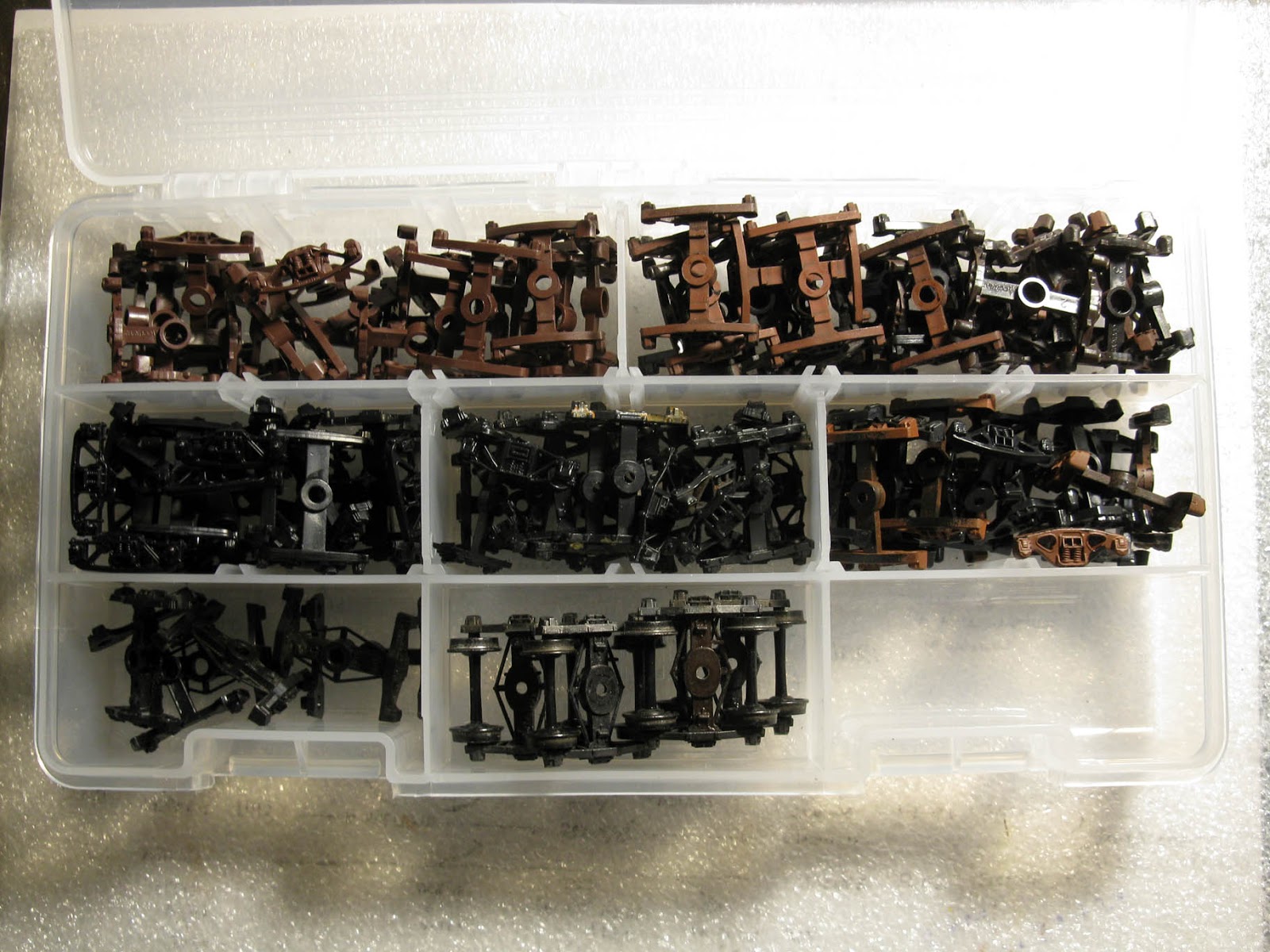
Taking care of various kind of trucks is easy with a bait storage case.

Then I purchased several fishing bait storage boxes and went through my growing inventory of freight car parts. All these details were in various cardboard boxes all over the house and I quickly lost the count over the years, often reordering parts I already had on hand but couldn't locate. Now, there is a box for trucks and wheels, one for brake rigging and ladders, and another for carbody parts such as roof, walkway, doors and car ends.

The sloped bottom makes retrieving parts easy.

Smaller parts such as grabirons and stirrups are stored in a pills organizer case, which is both handy and take very little space on the workbench.

Choosing windows, doors and structure details is now intuitive.

I also did the same with my structure detail parts and supplies. The bait storage boxes were perfect to put some order on hundreds of Tichy parts. Now, at a glimpse, I know which doors and windows I have. It was also a good excuse to take apart several old structures given by fellow modelers over the years. Most were unusable for our layout, including many European kits, and certainly glued together by the most unskilled people out there. We kept them for almost ten years thinking they could be useful some day for parts. Well, I took a few hours and removed every bit of details that were deem good enough including doors and windows. Everything else was trashed, freeing a substantial amount of space!

For scratchbuilding supplies, a second box containing styrene sheets of various size and texture, roofing material and larger parts was necessary. In my office closet, several hooks have been installed inside the door where Plastruct and Evergreen styrene profiles and brass rods and plates can now be seen easily.

Parts organizer for diesel and steam locomotives.

Each drawer is divided in two sections for sealed parts and loose parts.

Finally, I ended my journey by putting some order in my locomotive parts. Back in high school days, probably around 1998, I acquired a small part organizer and started to fill it with details. At first it went well, then all kind of junk ended up there. When I moved in my actual house in 2009, I put it in the back of a closet which was a bad idea. Accessing the organizer was quite hard and soon I stopped to go there. Meanwhile, I still had old scale model boxes from the 90s filled with parts and bits, including empty packages. The boxes were at full capacity and finding a diesel locomotive part required to go through about a hundred packages. Not very fun nor efficient. The solution was simple: clean up the parts organizer to use it exclusively for locomotive detail parts. Each drawers is now labelled according to its content, be it horns, bells, fan grills or rerail frogs. It was also a good occasion to throw away a bunch of useless stuff like plastic wheels, horn hook couplers, Atlas switch controls and other completely obsolete stuff.

Now, I still need to go through the decal collection, which is quite huge, the tools and paint, but the worst is now behind me and it is making my life much more easier. I'm glad I did it... I certainly don't understand how I could tolerate such a situation for two decades.

Monday, September 10, 2018

JMRI Operations & Layout Design

Most people see JMRI Operations and othr layout operation planning methodes (software assisted or manual) as a way to bring life to their layout. On the other hand, except a few extremely dedicated individuals, it is rarely used in the previous steps to get big picture of the prototype.

In my case, I'm a little bit late to the game with a layout almost set in stone. However, the last few week fine analysis of pictures and train movements on CFC helped me to create a JMRI prototypical freight traffic model. And it is an interesting because it better helps to understand how things moved over the rail and where some very specific task were performed.

After running more than 1000 simulations - which amount to three years of operation on Murray Bay - it became clear that replacing Montmorency with Wieland was a viable option. The traffic is stronger, car movements more frequent and a little bit more complex due to shuffling of cars between Clermont yard and there.


Villeneuve also took another twist by the addition of another prototypical movement that we never implemented on the layout: storing extra cars on a siding. CFC had the habit to leave cars there so they could pick them up if required. It had another layer of purpose and sense to this particular location. MoW material (ballast cars and snow plow) could also been spotted there before moving up to Clermont.

All in all, I'm glad to have put almost 4 complete days working out this JMRI model. Things are clearer and it will be easier to make choices later.It also feels there is a real outside world and dispatchers behind the trains instead of whimsically choosing cars out of the drawers. I'm looking forward in the next week when track will be back in action in Wieland to test these scenarios and further refine them.

While JMRI isn't a panacea and can't be the focus of layout planning, I still consider that for someone trying to model an entire subdivision, it can start to be another tool in the toolbox to determine how each location plays a part in a railway's daily life. Having to select only a very few elements, it is not bad to have some more factual data to help creating a realistic and engaging experience for operators.

Thursday, September 6, 2018

Finding inspiration...

Donohue switcher working Clermont yard

During my almost 5 day stay in hospital last week, I had plenty of time to think about the layout and look at inspiration once again. Hospital rooms, particularly when you are alone in them, are special capsules where you evade such notions as schedule, time or sense of purpose... You indefinitely wait and work your patience. But this can also be seen as a pure form of freedom which isn't a bad thing from time to time.

Bringing cars to Donohue paper mill over Malbaie River

While I didn't bring a lot of entertainment with me, I minded bringing my tablet thinking I would kill time watching series while in bed. But I had very little energy to spare watching long videos and finally started to look at CFC Murray Bay pictures shot during the 2000s by Jérôme. Having a lot of time meant I could start to analyze little details like car blocking, train movements, how cars were switched and mundane details in seemingly nondescript environments.

Train 523 leaving Beaupré after picking up newsprint loaded boxcars.

Here's a collection of a few pictures that made an enduring impact on me and which I consider represent the essence of railroading on Murray Bay Subdivision. You will quickly remark you won't find incredible panoramas and dramatic cliffs, but industrial settings where things used to happen. As I previously wrote, theses places are location where my interaction with CFC has been the most important.

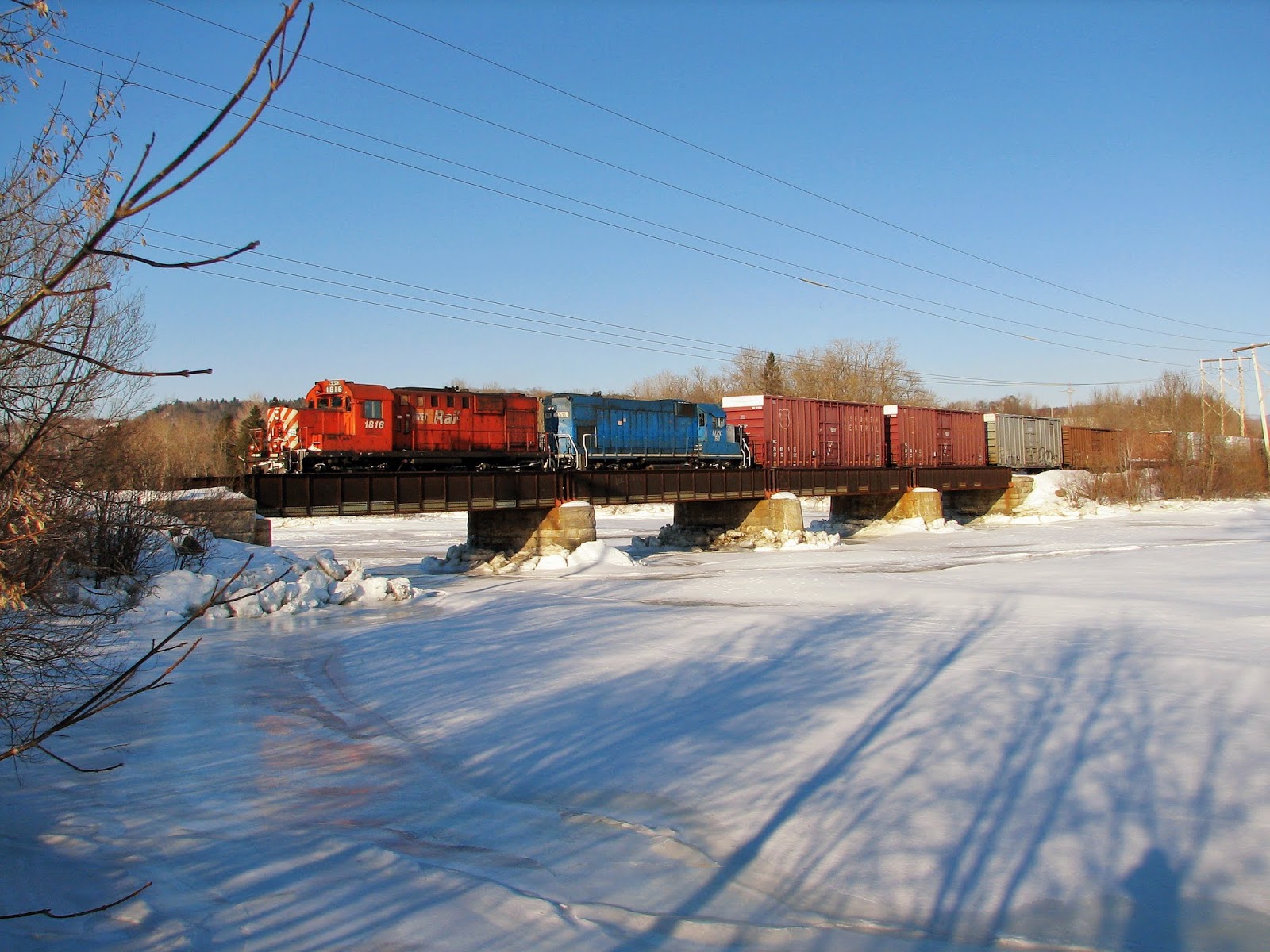
Train 523 crosses Ste. Anne River bridge in Beaupré

Wednesday, September 5, 2018

What To Model?

When it's time to design a layout, a crucial question will quickly arise and which must be addressed frankly: what should we model and what shouldn't be modelled. As you can expect, there is no recipe to make such choices which will be based on various conditions we have to live with (resources, space, time, skills and personal interests). However, it would be wrong to assume you can't replicate the general characteristics of a specific train run if you don't have all the pieces. As long as the story you tell make sense, your brain will fill up what's missing.

I previously compared layout design with a song "chorus-verses" structure. This analogy stay relevant at this next step. Just think about it, you probably know familiar songs by heart but often discovered less famous verses rarely used. They can be omitted without altering that much our appreciation, in such a similar way a song radio edit versus an album edit can vary in length.

In the case of a layout, it means you don't need to model everything to get a coherent and somewhat "complete". Many people will select a few locations, a particular industry and others bits they like and put them together. However, this can be tricky. If the selection is carefully done, you'll end up with a decent layout bolstered by a logical concept that link everything together. The missing parts will be similar to our edited song: barely noticeable. On the other hand, if the selection is whimsical and based on anecdote rather than what's typical, you get an incoherent patchwork of scenes which are extremely hard to logically link together with a coherent story. Unfortunately, most of the time, we go that route.

CFC network with main locations (1994-2011)

I'd like to use the CFC Murray Bay Subdivision to illustrate this with a case study. You probably recall a few days ago I said Villeneuve (cement plant) and Beaupré (paper mill) were equivalent in term of operation and interest. Superficially, they both are small yards where the local freight set out and pick up cars that are switched by industrial locomotive to feed large industry. But in fact, the comparison stops there. Upon closer examination of old timetables, pictures and videos, it has become clear that Beaupré was a much more important location on the railway line.

Original 1994 CFC track plan

Villeneuve is basically a siding where you pick up loaded cars and set out empties. Then you move forward to your next destination. On the other hand, Beaupré was where trains were broken or assembled. To save on fuel and keep trains shorter before entering the rickety topography of Charlevoix, cars picked up en route to Beaupré were left in the yard. This was because most customers had east facing sidings. It was useless to bring these car up to Clermont when their destination was Limoilou, thus they were left at Beaupré and picked up by the next westbound train (523). Now, add this small operation feature with serving the plant in Beaupré and you understand it was a location where a lot happened. In fact, you don't have to physically model some customers because their traffic is actively handled in Beaupré, which is quite a bonus!

Minimum useful trackage to keep operation coherent 

But better than than, a 1994 timetable indicates that it is possible switching at Beaupré isn't done yet by the paper mill and CFC trains must wait until 14:00 before leaving with these cars. This is quite interesting because it means an operator could run his train up to Beaupré, then control the switcher and prepare a cut of cars to be shipped to Limoilou. Then the local train leaves Beaupré. And to make things more interesting, a busy grade crossing was located in the middle of the yard, thus extra care was required to not impeded the important truck traffic serving the plant. It means cars must be blocked in certain ways and consists may have to be broken depending on condition.

Car blocking and train movement per location.

Why does it matters? The reason is simple, as things stand, the layout area depicting Villeneuve is quite underwhelming in term of efficiency. Beautiful, realistic and prototypical... but nothing really happens there. Most of the time, we run the train directly to Clermont which takes about 2 minutes and don't make a stop at Villeneuve most of the time. Picking up cars in Villeneuve isn't a great activity too. Thus, you end up with a 14' x 11' room (about 40' of main line) which basically only exist to take a train out of staging before moving it as soon as possible to the next room. Let's call this a serious design caveat! Villeneuve is nothing more than a vignette... a long one, but still a place where nothing really happen. And from a historical point of view, by 1997 the plant was closed and since the very early 1980s, it no longer received gypsum and coal by rail cars. Not a very impressive customer...

In the case of Beaupré, the mill was still strong up until the late 2000s. Railway employees had to take decision there depending on condition and various train movements made sure it wasn't a pit stop in a F1 race. And that's the key element: at Beaupré you take decision... in Villeneuve you do as per instruction like a robot. From an operator perspective, the choice is easy.

And that's the important key feature of Beaupré in regard to how to decide if you model or not a location. Beaupré and Villeneuve handle the same amount of cars, but they don't have the same relevance. If I had to make a choice, I would choose Beaupré because the layout room would be a large comprehensive scene where an operator can be kept busy at his "operation station" for a while. The room and scene would have a purpose, which is dramatically lacking in Villeneuve. And it makes sense since real railroads don't give a damn about stuff that no longer as a purpose. It should be the same with a layout.

Another interesting aspect of choosing Beaupré over Villeneuve is about replicating the essence of a particular prototype. I've often wrote about my admiration for Tom Johnson's Inrail layout based on an Indiana branchline fully dedicated to serving feedmills and grain elevator. Tom's layout isn't the greatest our there in term of scope, size or goals, but it shines because it sings a song about the harvest season. All the towns and empty space between share are similar tone that create a strong feeling of travelling a particular part of a country. Each grain elevators, which are basically similar, makes the theme even more stronger, creating a sense of immersion, of realism and of purpose rarely equaled. In that regard, focusing Hedley-Junction on paper and lumber products is probably the best way to convey what characterized the line up until the effective end of freight service in 2011.

Having two paper mills, both similar yet different in the way they interacted with the railroad, give a powerful sense of purpose to the layout while making it highly coherent. It also provides two large and mostly prototypical scenes instead of a collection of poorly grafted together locales. Each scene immerse the operator in a different world where multiple tasks must be carefully handled... And each room end up with very scenic elements such as large rivers and bridges that are exquisite railfanning spot.

At the end of the day, after almost two intense weeks of research and thinking, I must admit modelling the Murray Bay Subdivision as a comprehensive layout is easier to achieve when done as a modern railray. Like anybody, I started with the 1950s as a benchmark for optimal operation opportunities. This wrong assumption was based on the idea since trains were still dominant in that decade and served virtually all industries, the potential and interest was higher. With the time, I have come to understand potential and interest aren't related to quantity. The early 2000s Murray Bay may have been seen as a plain branchline without redeeming factor, but in fact, it was much more interesting that trying to figure out what happened in the 1960s, 1970s and 1980s when nobody cared about documenting the railroad except for a few rare steam excursion.

That brings me to my last point about choosing what to model. At one point, you've got to do what you can with what you have. Up to 1994, it's quite hard to understand what really happened on the Murray Bay in respect to freight operation. We have glimpses here and there, but not a general portrait of what really happened. From a cosmetic point of view, that may be fine, but it's clearly not enough to create a coherent story - a song - about the railroad. I struggled a lot trying to do so... and failed more than once. Only the Donohue plant worked because the available data was comprehensive and we knew exactly what happened there. Jack Burgess - which have been quite vocal recently about his excellent Yosemite Valley Railroad layout - stressed how having access to a lot of quality data convinced him it was possible to replicate the railroad as it was. The same applies to our project; after 1994 we know exactly what happens. We look at a train and we can determine which customer a specific block of cars is for. We know each locomotives and their operation history and have a good grasp of how things were handled. It's not a matter of being lazy, but this is convenient and makes layout design and operation far much easier. Knowing so much how things happened enable us to make definite and coherent choices about what to model and what to not model... And at the end of the day, you can even look at the official track diagram and select the best verses and keep them in your layout "radio edit"

Monday, September 3, 2018

Learning how to approach Layout Design

The revised concept of Clermont is basically built around what I would call "operation stations", which are areas dedicated to intense interaction with trains. As previous described in a recent post, these stations are located where high concentration of turnouts or mechanical devices can be found and act as verses of a song to tell a story.

Murray Bay in a nut shell

Such stations - and I think this is the right word for this concept - are places where an operator is generally standing without moving that much while his focus is on what's going on. These are perfect spots to "railfan" the train crawling at slow speed and it wouldn't be that hard to imagine such part of the layout as a self-contained switching or cameo layouts. This concept finding its way on a medium sized basement filling empire is probably not surprising to regular readers. In fact, I think it isn't a bad thing to implement such an approach to a larger layout if the goal isn't about running fast trains but rather on appreciating them from the trackside. None of these approaches is better than another, it's only a matter of making a well thought choice relevant to your interests, habits and resources.

As such, I made a remark to Louis-Marie on Sunday afternoon about how our layout had been so badly thought and built upon wrong premises. The entire project was plagued by whimsical decisions, mood swings and a poor understanding of how we like to run a layout. Important decisions about how we interact with trains for "real" were an after thought. It seems to me we put so much effort trying to replicate iconic scenes or well-known rolling stock that we completely forgot to respect our theme. No wonder it became a frustrating checklist instead of a coherent story. The most frustrating part is I was already refining my approach to model railroading at that time. But it seems my grasp was better on smaller designs than larger projects.

Larger projects are hard to manage because they forces you to make choices among many, many possibilities. There is also the illusion that if you don't implement a certain amount of iconic elements, your rendition of the prototype will be a failure... which is not the case.

To be honest, dealing with a very small layout is far much easier. From the start, you know you will have to only keep a few relevant elements and build around their strengths instead of creating a collection of vignettes. This "collection" effect is generally what will kill the coherence of a larger design.

In the case of Hedley Junction, it is clear we took a long time understanding what we really wanted to do. For a long time, we thought running long trains on the mainline would be the big element. But in fact, the switching of very specific industries quickly took hold and eclipsed everything else. Unfortunately, we couldn't conceive representing an entire subdivision with only a few very spots. If I learned something from designing switching layouts, it's that you don't require to model the entire story. Only a few glimpses, in the same fashion when you railfan a specific line, you will only see a fraction of scenes and actions, but nevertheless relevant ones that have a significant impact on your imagination.

If your goal isn't about replicating a complete operation day, which is rarely the case or possible, things start to be more clearer. Murray Bay subdivision was basically a shortline hauling newsprint and lumber products. All the other stuff was extremely marginal. Most action occured at Clermont yard where inbound and outbound trains were built or broken and Donohue where an industrial switcher served the paper mill. Wieland was a satellite location where lumber was loaded and MoW performed occasionally. At Beaupré, the paper mill was similar, thus irrelevant on the layout at this point. Some lumber was picked up in Château-Richer and finally cement cars at Ciment St-Laurent. In between, nothing really happened.

In the case of a layout, what matters are only a few key elements. Donohue must be replicated as close to prototype as possible to make sense. The yard is also a key element for smooth operation. Wieland doesn't require to be fully modelled to get a good picture of the area. As long as you can pick up and set up flat cars, you're in business. As for the cement plant, it's not bad to do it as close as it was since it is home of intense activity. In that regard, someone could simply choose to represent the Abitibi-Price paper mill in Beaupré. This one wouldn't need to be fully depicted, only the tracks where the train set out the cars on a siding. The plant switcher wouldn't be required to be modelled since it is irrelevant to the story and Donohue can be done in a far more compelling way. However, this second paper mill is a good way to reinforce the layout theme based on newsprint hauling. And truth to be told, this being a customer located on line and not at a terminal, the work isn't done in the same way as would be with Donohue, bringing a welcome variety. That said, it must be noted operation at Ciment St-Laurent isn't really different from Abitibi-Price.

As you can see, a story emerge... a local train serving paper mills in quite scenic areas that are visually interesting with their strong railroad flavour. We have a sense of slow motion, large masses of steel being shuffled around, bridges over powerful rivers that once powered generic small industrial towns. And from there, we can start to design a track plan based on a story, with its chorus and verses. And, I believe, get a result that is manageable, but also compelling and that draws you into the scene and action. This is what I call layout design... this is what I call setting up a stage for our trains. From there, making choices is far easier, because we already know what matters and what are our goals. Depending on the song you want to write, you'll get a very different set of parameters and themes, but you'll be able to reach a goal worth of your efforts and that will pride your intellect.

And that brings me to my last point. Layout design is hard... really hard. Countless and useless books have been written about that. Most of them spread between the "I Want It All" mentality and the mostly useless Givens and Druthers (which are basically things you start to really care about only when you have a decent idea of what you are trying to do). My main complain is that very few people step out of their hyped bubble to look at things for what they are. Everything is driven by pure passion - which is fine to some extent since it is a hobby - but most mental efforts are wasted on "How" to do things rather than "Why"... we generally end up with a lot of stuff done and bought... and still crying we didn't accomplish anything. Sad isn't it? Yes it is... I would seriously feel bad if I approached my professional practice with such an attitude. Yet, I still do it with railroading.

My goal isn't to discourage anybody... on the contrary! But rather to encourage people to develop courage to go beyond their first epidermic reaction with this hobby and seek truly what is the essence of what they like about it. The good thing is we are all different and thus great diversity makes this hobby a fascinating place. But also a good thing is that all these half-baked efforts aren't for nothing, as long as we learn something from each step, becoming more proficient at each iteration. I made a lot of mistakes myself yet I'm happy to have made them because I had the courage to share them with you and try to find out what happened... and just for this reason, I consider blogging about this passion was probably the best decision I took because it forced me to put in words and articulate my feelings, helping me to see what was worth and what wasn't...