Tuesday, October 17, 2023

Return to Monk Subdivision

Last September, when the fall colors were still subtle and  subdued, I went to Bellechasse to hunt for backdrop pictures and visit a few spots I missed last time I followed the old National Transcontinental Railway roadbed.


It was one of these strange autumn days when nights are cool and days are warm, generating a deep fog that clings on hill and wood. This luminous and eerie ambiance was perfect for a road trip yet a little bit less for backdrop photographs since Appalachian mountains were virtually invisible to the naked eye even if they were only a few miles away. That said, they were plenty of good opportunities and I didn’t miss them when they shown up!


As expected, railfanning the old NTR is a fool’s errand in the sense that there is very little to see and most of the adventure is about driving long rural roads dotted with colonization era farmhouses, crumbling barns and lost fields. Forest is regaining its rights in these countries and soon, nothing will be left to be seen. That said, I was for a great start when the main street leading to Tourville (Monk station) gently curved around the calm and beautiful Lac Noir (Black Lake). Serene and scenic, the lake reminded me I entered a territory well known for being a sportsman paradise.
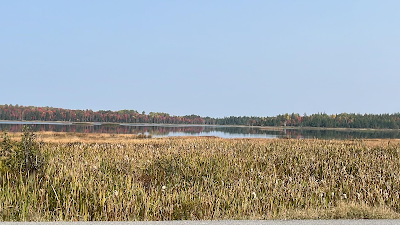
Lac Noir, in Tourville


Tourville was, as always, that sleepy town it has been since 1955 when the steam locomotive shops were closed down. That said, while it’s no longer the vibrant place it used to be, it’s still quite alive due to a renewed touristic vocation. Taking the gravel road westward, my goal was to finally get a glimpse of the causeway at Lac Therrien which was immortalized to vividly by the late Richard Manicom back in 1963.


Google Maps indicated a parking lot and a hiking trail leading to the Monk subdivision under the pompous Tourville Nature Park which convinced me it would be relatively easy to reach the roadbed… however, as is always the case, the parking lot was inexistant and the hiking trail was long lost to nature. My only choice was to park the car by the ditch and walk a muddy ATV trail. Since it was the beginning of hunting season, I wore my bright orange pullover, but it didn’t feel safe to walk there alone! But Monk always reserve surprises and after a while, the muddy path was consolidated by using wood planks… or should I say, old railway ties. Unmistakably, the roadbed was nearby and sure it was.


NTR ties are always found where you least expect them

I climbed the gentle slope of the fill then found myself in the middle of a long straight corridor lined with conifers until it vanished into the horizon on both side. That was the hallmark of NTR exacting standards of construction applied in the most remote areas. On the right, toward Tourville, I could see a break in scenery that was the old bridge over the lake discharge. Under normal circumstances, I would have taken the Nature Park trail up there, but that would be for another time. I turned on my left and walked for about 500m until I reached the old causeway.

The causeway reveals itself after a short walk

In any circumstance, there is nothing exceptional about Lac Therrien. It’s one of these thousands of similar lakes that can be found everywhere in Canada, yet that’s why it’s interesting because it’s such a classic sight. At that point, as was common with railway building practices of the time, the roadbed was built at the boundary between the lake and the marshes. In early Autumn, the marshes were covered in a beautiful array of colors ranging from various greens to yellows. Straw color, brown and reddish hues completed that mundane yet subtle landscape painting. In the middle of nature, nothing could be heard and a peaceful feeling filled the place.
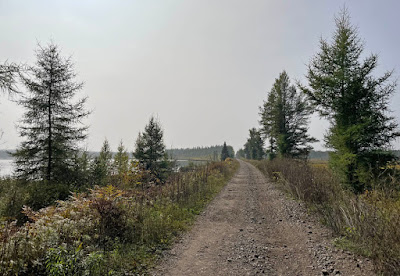
A large marsh lies north of the causeway

After meeting a few peoples on ATV, I started to explore the causeways and soon, details started to pop up. I was looking for a small steel deck bridge over the creek, but was welcomed by a concrete culvert. At some points, big lumber were added to the original structure to widen it. But at the time of my visit, they were crumbling and sliding down the causeway. Nevertheless, I went down and stood on them to get a better glimpse of the culvert. It was quite obscured by the fallen lumbers, but a quick examination shown the concrete was in perfect condition after all these years. Better, a built date could be still read on the span: 1913, which was consistent with the first year of operation under Intercolonial Railway care in 1914.
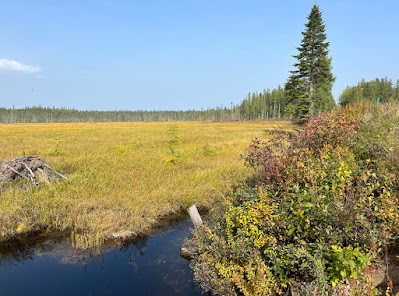
 

This culvert was built in 1913

Nearby in the dark stagnant water of the marshes was a straight stump from a tree, but that also revealed itself to be the remnant of a telegraph pole. I would discover later that is was common practice to install the lines right in the water when crossing water courses on the NTR. I then proceeded to shoot several panoramic pictures with the goal of replicating that neat scenery on the home layout. When walking back to the car, I was tempted to walk another 1.5km to reach the other bridge, but decided to postpone that trek due to active hunters and a sun that was going down faster than I thought.


An old telegraph pole blending into the landscape

Driving on the country roads, I could see the fog starting to gather faster than I thought. I stopped in several places to shoot typical Appalachian landscapes, but I perfectly knew most of them would be unusable. When I reached Ste-Apolline-de-Patton, you could have bet a wildfire was in the area.
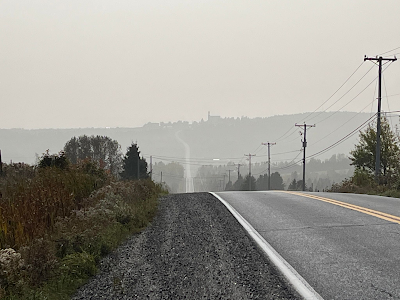
 

Atmospherical fog layering Ste. Apolline's landscape

From that point on, I decided to change my plans and drive to Armagh as fast as I could. In Ste. Euphémie, I tried to shoot the classic Ken Goslett scene, but trees had completely obscured the sight and it was no longer possible to replicate it. The concrete culvert was barely visible, yet the old houses and barns were still standing.


In Armagh, road construction blocked the main route and I had to take a rickety detour which yielded a couple of nice panoramas that could have some use on the layout. So, when I thought my trip was just a fun autumn ride, it finally provided some results. It was time to go back home before the sunset.


It was the third time I visited Monk Subdivision and it left the same weird feeling about the NTR. The malaise of seeing such beautiful track standards but serving almost no tangible goals, except political ones, is quite strange. A weird mix of being baffled by a nonsensical piece of work yet astounded by the skills and resources poured into it.  I’m not done with the NTR in Quebec and will need to revisit it again and again to make sense of that Transcontinental that could have been…

Monday, September 18, 2023

Brique Citadelle - Part 2

The next logical step to Brique Citadelle is painting and installing the road better known as Avenue du Sous-bois which used to be the main access to this industrial park until the late 1990s.


I'm certainly no reinventing the recipe. Not by fear of experimenting, but because I want the layout to have a common color palette and techniques to bring in an air of familiarity. As I mentioned in a recent post, just using some different color grass can have a huge impact and I certainly didn't want to gamble.

As always, it's a carboard road painted with Krylon grey primer and camouflage beige. Some light airbrushing blends everything together and add a touch of blue to better capture local tarmac. Powders and colored pencils finish up the road, which is then glued in place with latex caulk. 


Grass is the same blend I always used. The static grass applicator was helpful for some zones, but I must admit I preferred to complete the job with my own fingers. It seems to me each techniques has pros and cons, hence they need to be mixed together to yield the best results.


There are still a lot of things to do, but this area of the layout is taking shape nicely. I particularly love its understated appearance. Indeed, I'll need to add more grass and more ground cover, but I'm not planning to crowd the place with more than a few bushes and trees, utility poles and probably a weathered Volvo front loader reminding us that the site is currently being decontaminated for future redevelopment.

Tuesday, September 12, 2023

Quebec South Shore Railway - Mark IV: Resurrecting an Old Idea (again)


Several recent conversations with Chris Mears resparkled my interest in exploring shelf layouts as whimsical explorations of possibilities in model railroading. Since I’m cleaning the basement in hope of building new partitions for a storage room and a staging for Monk Subdivision, it gives me some time to dabble in that experiment yet again. Also, since it’s a big cleaning, I getting rid of several building supplies which I have no longer any use for and clutter my basement. These include scraps of foam, old cork rolls, various pieces of wood and plywood leftovers. Giving them a second life before the landfill or recycling makes sense and they cost virtually nothing. Track is recycled too from the original Monk staging which was recently dismantled.


As you know, I’ve designed and built several small layouts over the last decade. It’s a pet subject of mine which is rooted in nostalgia, desire for design challenge and probably a remnant of having been starved for space when I was a teenager living in a very small house. That said, I don’t see small layouts has a limitation because they drive you to understand how train movements work and how much real estate they require. These mathematical equations thus become ingrained in your mental muscle memory and can be put into action when designing larger layout.


My most recent explorations included Donnacona, which I still have in the back of my mind and St-Pie, a farming locality in Southern Quebec that used to be served by CP and later, by the infamous MMA. While extremely interesting project, both of them were bulky even if they footprint was 6 feet long by 15’’ wide. I used traditional carpentry to build them and thus, they were quite heavy, making them less than perfect for something that was supposed to be easy to move around. I may revisit these ideas, but what Chris is doing with his current shelf project (see his wonderful Prince Street blog for more info) kind of gave a second life to my desire to have a small plank for whimsical operation at my desk and photo opportunity.


Chris has been exploring ways of building fast, building cheap and building lightweight. He used ½ foam that he layers and glue down cork with double faced carpet tape. McDonald’s napkins are glued as a scenic base with latex interior paint and he starts pouring scenic materials right away. Let’s just say it outright, Chris and I share the same issues: we are both enthusiastic about everything train and impatient. Fortunately, there is a reliable backbone to this madness which is our love of mundane railroading. At a meeting earlier this year at Hunther Hughson’s house, he demonstrated a slice of that layout building technique and let’s just say we were all impressed with the results. In his proverbial humility, Chris downplayed a little bit the system, but it’s certainly a viable option for many people. And he handled these little pieces of layout very roughly over the years, including several trip in his backpack, to make sure it could last… and sure it did.


Another experiment that impressed me was my own photoshoot module I completed earlier this summer. It was built several years ago using a piece of 1’’ foam framed with some pieces of wood. It was cheap… dirt cheap and was left for years in Louis-Marie’s basement, exposed to humidity and temperature variation. I was pretty sure it would warp badly, but it did survive… Better, it’s feather light, making it perfect to move around depending on lighting conditions for pictures. Certainly, I could use something like that for a layout. At that point, I knew I had enough meaningful information to make a decision. And I certainly set myself a goal that it wasn’t a permanent layout, but only an experiment to push as far as I could.


The track plan was derived from the classic British tradition, which means a passing track (loop) and a siding. I know I have a strong hatred of overcomplicated staging devices, so I gave myself the challenge of making sure all the actions would fit within the layout boundaries, except a short shunting lead.


The footprint was based on dimensions that I felt would be easy to move around between my train room, my office and my workshop. 6 feet long is nice, but 5 feet fits perfectly my Ikea Kallax shelves and my desk. Also, it’s long enough to feel immersed within the scene. It may seems short, but it’s enough to handle a 4 cars long train and a locomotive, which is plenty enough for a single industry layout.


Depth is also another crucial parameter and I elected to keep it at 12’’. It’s a standard measure and makes for a layout that is easier to handle. At 16’’, it can be an issue under some conditions. Since the Kallax shelves are 15’’-16’’ wide, it leaves enough room at the back to keep decorations and objects displayed on the wall were they are.


Now, what’s the theme? Nothing more than the old Quebec South Shore Railway from years ago with the small feed mill. I reworked the track plan to be tighter, but everything else is the same, including the ubiquitous Highway 20 concrete overpass used as a scenic break. I always loved the simplicity of that design and felt it was worth revisiting once more. It’s also suitable for various eras, from the 1950s up to the 2020s. It can be a MMA/CMQ line were larger modern covered hoppers are shuffled around, or something older where 40ft reefers and boxcars are running along B/A tank cars, stock cars and coal hoppers.


At the moment of writing this article, which is about 3 days after construction started, I can confirm it’s taking shape. At first, I built a light pine frame covered with a melamine shelf. I quickly discovered it was far too heavy and replaced it with ¼” lightweight plywood. I haven’t reinforced yet that baseboard, but I may be tempted to add some braces underneath. It would then be easy to convert it into a torsion box if ever required. It must be stressed the great quality of Chris’ modus operandi is to refrain from using wet products on the baseboard, preferring glues and carpet tape to protect it from humidity.


This basic baseboard was covered with 1’’ thick foam secured with No More Nails adhesive. This protect the plywood from wet scenery process and provide enough depth to carve ditches and play with topography. Cork roadbed isn’t glued but kept in place by double face carpet tape. The same tape is also used to secure tracks to cork. This is not an ideal technique because you can’t move around the tracks were there are secured to the tape. It’s almost impossible to move it again if you pressed it firmly onto the tape. The bond is almost instantaneous like CA glue which can be seen as an advantage and a serious caveat. Nevertheless, I had so little track to install it was manageable.


More to come as I continue developing this small layout concept. I have also several other designs in mind, including another British-type micro layout based on a 32" x 9.5" floating shelf.

Saturday, September 2, 2023

Brique Citadelle - Part 1

Brique Citadelle used to be a major brick maker in Quebec until its spectacular demise at the end of the 1980s and early 1990s. Engulfed in several multi million dollars lawsuit regarding catastrophic quality control that led so several building enveloppe failures, the company which roots went back to the late 19th century, sank like a rock at the bottom of the proverbial pond.


While all that happened when I was was an elementary school kid, I can still clearly recall the intricate structures that made the plant. Each Saturday noon, we would take the industrial road behind  the plant to reach a well-known snack bar after visiting my grandparents living in Villeneuve or shopping in town. The brick and corrugated steel structures were covered in a reddish clay powder that gave an eerie Martian look to the compound. By the mid-1990s, it was in serious disrepair and everything was demolished, leaving piles of rubbles and concrete pads that would endure well into the mid 2000s. I recall the concrete floor was once used by a bike driving school as their formation center.


When the neighboring cement plant went down a few years after Brique Citadelle demise, projects started to emerge. Redeveloping are became a thing and the old industrial remnants were removed and soil decontaminated. At the time our layout is set, Brique Citadelle was nothing more that an abandonned fields with growing vegetation, dirt roads and piles of gravels and discarded demolition bricks. That's exactly what I wanted to replicate: a demolished and long gone industrial structure.


It all started with a coat of universal mud, aka Celluclay mixed with interior latex paint. A thin coat, about 1/16'' to 1/8'' was apply on which I poured sifted sand, various small rocks and scale bricks I once bought from Eastern Europe for that very purpose. They were available in all scales, including HO. They are generally used for military dioramas and are made from clay, which gives them a very realistic texture.


Most bricks were pushed into the mud with my fingers to show they had been mix with the ground and ran over by trucks for years. Others were simply left as piles on the surface. A light sprinkling of limestone powder was applied to merge the bricks with the surrounding. They look quite shiny and new and will require some weathering at a later date.

Before everything had dried, I started to apply some static grass by hand as I usually do, followed by crushed dead leaves and ground foam. I tried to overdo it it, leaving enough bare ground visible to suggested trucks and heavy equipment are frequent visitors.


When the background scene was done, I move my attention to the foreground where I started scenery last week. I didn't like it because I ran out of my regular static grass. Using different colors and jute rope to achieve the same blend was a foolish errand. Hence why we ordered the old stuff during the week.


There is still a lot of work to do with this scene, including trees, ground weathering and small details such as relay boxes and bushes. However, I'm quite happy of how it turned out. More grass will be applied on siding tracks to tie up this scene with the cement plant, but that's a footnote as far as I'm concerned.


A few unexpected results of this new scenery is it makes the mainline look longer and the lighter shade of ground makes it more luminous, two thing that works in our favour. I can't wait to finish the road and continue this work.

Saturday, August 26, 2023

Restarting the Modelling Season

The last two months have been quite calm due to vacations outside the country and taking some time off after the big effort to complete the Charlevoix section of the layout. There are still some little elements to add or finish, but we can consider it mostly done. Thus our attention is turning toward an area that was left alone for too long. In fact, many years!

First train of the season, fresh from the shops!


Indeed, it's time to work again on Villeneuve, with fresh eyes and experience gained while working on Charlevoix. Lots have been discussed yesterday, including inverting the scenes, adding an overpass and other ill-thought schemes. As always, after exploring crazy ideas, we generally go back to the original plan! Which is to complete the scene as it was originally designed. While it could be interesting to remodel Villeneuve, we have to keep in mind the track plan was carefully designed and swapping elements that seem trivial could lead to serious operational incongruities.


Track plan and operation aside, the big challenge is getting the backdrop right. As most of you know, the cement plant was demolished a little bit less than 20 years ago and the land has been redeveloped as condos. It's virtually impossible to take pictures of the area and expect it fits an industrial setting anymore. Also, with trees growing a lot since then, many vistas are now impossible to capture on camera. Something else will need to be done... another similar area with similar topography.


Another big issue is using if we really want to continue the early leafless spring theme. This comes with several limitations, including the difficulty to cut the tree line on a photo. Sure, we could print the sky too, but we have had not stellar results in Charlevoix due to humidity affecting the paper. Also, it's quite hard to install full length backdrops. Another issue is that leafless trees are the greatest thing to hide seams, gaps, building junctions with backdrop, etc. Vegetation is great to hide what should be hidden. Don't get me wrong, I like the leafless season, but something must be done.

A quick grass test near Villenuve


First, Clermont is north of Quebec City, in the mountains. Spring starts later there, maybe one week or two. It would mean that if leaves start to appear in Clermont, then they would be fully there in Quebec City. Certainly, they would have a tender green to them, but there would be leaves.


We think it would be easier to shoot adequate pictures in that time of the year, making our life easier. Meanwhile, we could wait until next spring to take pictures and start the scenery right now, leaving a small gap to insert the photobackdrop later. We did the same in Clermont and it worked well.


This backdrop issue aside, our biggest challenge will be to complete the structures. The large cement plant will need to be enlarged at the back. It will be fully modelled. The bagging plant is almost ready to receive its cladding and details and several ancillary buildings could be done rather quickly. As for cladding, I now have a very hard time finding HO scale suitable corrugated cardboard to imitate asbestos panels. From now on, I think I will simply 3D print them according to my needs. It will be more cost efficient and prototypical that way.


I'm really looking forward to start modelling again.

Highball! A new season arrive...

On a positive note, Jérôme was able to revive our duo of GP-15s. Better sounds and keep alives have now made them very reliable locomotives, so all the frustrations associated with poor performance are gone... at least for now!