Wednesday, February 1, 2023

Grand Trunk Railway Caboose

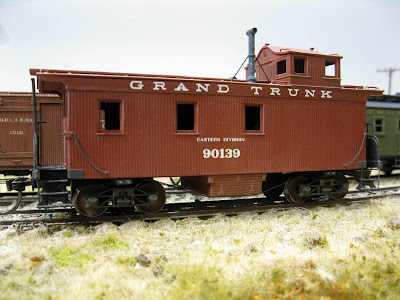
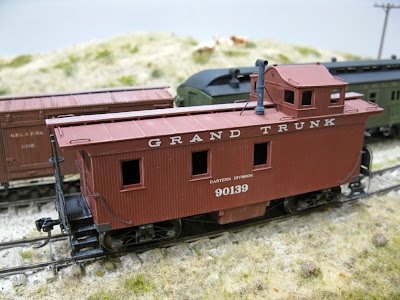
Sometimes it takes times to come around and completed (or almost) a project. The GTR caboose was a novelty project of mine to try something old time, barely modelled and cool looking. Data was gathered from old car building encyclopedias, scale drawings in magazines and examining countless historical pictures. Several attempt were made, including many that failed. I try to over engineer the model as if it was plastic only to discover 3D printed resin isn't forgiving to structural stress during the printing process. 


Then, I discussed the project with Pierre Oliver of Yarmouth Model Works, who prompted me to model different cupolas to replicate several other cabooses that were based on the GTR original drawings. After a while, I let the project sit on my shelf, forgot about until two months ago when it became quite obvious I should get some sense of closure.


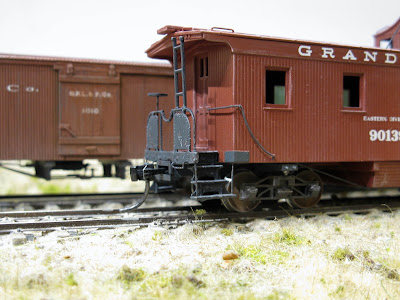
I fired up the printer and produced the missing parts. I also printed the trucks in one part, which worked quite well. Some brass rods, phosphore bronze grabiron, a coat of paint and weathering and voilà. I even used my custom decals to letter it.


At the end of the day, it was a fun project. It's both original yet down to earth. A lot of thoughts were poured in it, but it was well worth the effort. It was a pleasure to see it take shape under my eyes and bring to life something that nobody still alive has probably ever seen. It's probably what I like the most about old time model railroading, it brings to the real world artefact of an other era that have long been gone.

Friday, January 27, 2023

Railroad Hobby Show, West Springfield, MA

For those interested and that may attend, just to let you that I'll pay a visit to the Railroad Hobby Show in West Spingfield, MA this weekend.


Feel free to talk to me if you recognize me which may be quite unlikely!

Tuesday, January 24, 2023

More Vintage Fowler Boxcars

It seems changing job means less time to post on Hedley Junction. I wish my posting could be on par with my modelling frenzy to be honest! But putting that aside, today I share more oldies: Accurail shells with custom decals. As a matter of fact, I'd like to give a shout out to William Brillinger who did a terrific job at printing the decals. Don't consider it an ad, but just a token of appreciation for the honest advices he gave me and the quality product he provided.


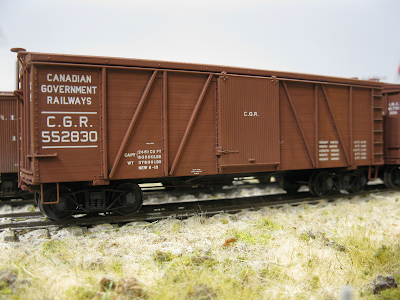
The first car is rarely modelled in HO or any other scale to be perfectly honest. The Canadian Government Railway car depicts an order of 5000 cars placed in 1917 equipped with Andrews trucks (a previous one of 1000 car having been placed in 1916). CGR was a crown corporation that managed the assets of various government owned railways and CNoR until the Canadian National was officially created. CGR placed the orders and distributed the rolling stock and locomotives according to the needs of each railway. Many of CNR large modern steamers trace their origins in these orders.


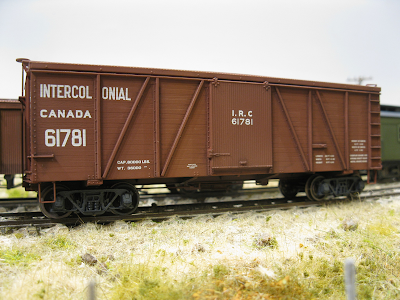
As for Intercolonial, they placed many orders between 1912 and 1914 for a total of almost 6000 cars. Being built years before the CGR ones, they rode on archbar trucks. I used Tahoe trucks which I consider a little bit pricey, but excellent in quality, very crisp, free rolling and worth every penny. They differed from the Accurail cars because they had a 5 feet door instead of a 6 feet one. Westerfield resin kits provide a more prototypical starting point for those interested in greater accuracy.


In the future, I wish to replicate a 1917 Canadian Northern Fowler car and several CPR prototypes and variants. At that point, I will have modelled almost every pre-1918 variations in Canada. If some people are aware of other Canadian railways owning Fowler cars before 1918, let me know! I've never seen a Grand Trunk Pacific Fowler car picture and would like to replicate one.

Wednesday, January 11, 2023

Great Northern Railway of Canada 34ft Boxcar


In the « Most Pretentious Railway Name In Canada » category, the Great Northern Railway of Canada is a serious nominee. The French version of the name was even worse, giving birth to a contrived translation that was so long it covered almost an entire side of the car. On the other hand, it must be acknowledged that at that time, only a handful of railways painted their French corporate name on their rolling stock. To my knowledge, only “Chemin de fer de Colonisation de Montfort”, “Chemin de fer Québec Montréal Ottawa & Occidental” and Chemin de fer de la Baie des Ha! Ha! did so. Most lines in Quebec City area generally went by with an English name even if a good chunk of the board and customers spoke French (which to be honest, was a serious rarity). It was, in a sense, more fashionable. In France, railways generally kept their name very short and poetic instead (Paris-Orléans, Chemin de fer du Nord or Paris-Lyon-Méditerranée). 


That said, the Great Northern is still remembered faintly in Limoilou where the old mainline is sometime refered to as “Le Grand Nord”. Aside that pompous name, GNRofC was a successful quick money scheme deviced by the infamous Charles N. Armstrong and John Eno, an American who fled to Canada to escape prosecution. The goal was to create a direct line between the Canadian Atlantic Railway and Quebec City to cut travelling distance by 800 miles and tap into the lucrative lumber and grain trades. Started in 1892, but fully completed in 1900, the line became highly profitable by becoming a grain pipeline between Depot Harbour and Bassin Louise in Quebec City. It was the fastest and most direct line to ship grain on the Atlantic and grain trains would depart at every 20 minutes in peak season. In 1907, C.N. Armstrong was able to sell that line to Canadian Northern who quickly made improvement with the goal of making it the backbone of it’s Eastern transcontinental line. The route was shortened by building a cutoff crossing Portneuf County between Garneau and Cap-Rouge. Had CNoR succeeded in its plan, this line would have reached Nova Scotia following a route similar to the National Transcontinental. In 1909, the Great Northern elevator in Quebec City caught fire and started a conflagration. The beautiful neoclassical Custom House was set ablaze and burned down, but was rebuilt quickly. While GNRofC and CNoR are distant souvenirs from the past, the mainline they built is now a major link between Montréal, Abitibi and Lake St. John.

Wednesday, January 4, 2023

GTR 2215 - A Classic 4-4-0

I intended to post a lot about my current old time projects, yet failed miserably because I was too immersed building these models. So nothing of value was really lost because it means more stuff to share.

Having a good locomotive on a project is generally the face of the layout. It's the ambassador, the motivator and the enabler all wrapped in one. A personal link is created between us and the overall world we try to create. Probably because the locomotive is generally where the human element plays a crucial role on the railway stage.

For this reason, I wanted to capture the essence of a classic Grand Trunk locomotive in the early 1910s. While Grand Trunk did use a lot of engine type, it must be acknowledge they had a humongous fleet of 4-4-0s crisscrossing the country from the 1850s up to the 1920s when many of these locomotives found a new life under Canadian National. Look online or in book, if you find a GTR pictures, odds it's a 4-4-0 are  extremely high...

Cows and engines are mutual friends, as long as there's a fence!

Interestingly enough, GTR 4-4-0s weren't generic but rather peculiar in appearance because Grand Trunk maintained huge locomotive shops in Pointe-Saint-Charles near Montréal. Several thousands people worked there, repairing, maintaining but also building entire locomotives from parts or scratch. Even the engines acquired for other manufacturers were poised to get rebuilt with typical GTR features such as slatted pilots, typical headlights and ubiquitous torpedo shaped steam domes. While paint schemes varied a lot in the early days, by the 1890s, GTR settled upon an austere black scheme with white lining. Some would say GTR was getting extremely cheap, which was true, but it was also the trend elsewhere in North America where ornate locomotives were getting slicker as the mid-1800s fad died out. I would try to capture that early 20th century vibe as much as I could.


To recreate such an engine, I started with a Bachmann Modern 4-4-0, which is probably one of the great RTR small steamer on the market. Bachmann was smart enough to provide a lot of customization opportunities to recreate various locomotives. All domes can be swapped for three different styles. The same apply to the stack, cab (wooden and two different steel ones) and pilots. This is, to my mind, a great way to get the most you can out of a tooling and a chassis. Also, the boiler and cabs are die cast, giving enough weight for the locomotive to perform adequatly.


Modifications were done on cab windows that were too small and the wrong shape. Hours of careful filing was required, but it was well worth my time. Modern domes were modified using Magic Sculpt putty and some custom 3D printed valve bonnet. Running boards were altered and the tender letterboards completely redone with new tool boxes. 

A crew is life...

Painting was straightforward and I used a lightly faded black paint. I could have gone with grimy black, but I have no idea what type of weathering I'll apply and GTR locomotives back then were quite clean and shiny. Decals were provided by Black Cat Publishing who made our lives easier since the old CDS Lettering dry transfers are getting hard to source and not always reliable to apply.


Once the locomotive was completed, it felt drab and soulless, which was a disappointment. It needed some figures to add life. Finding Edwardian locomotive drivers isn't exactly easy. A few figure makers in UK propose such products, but the people depicted are a little bit too British in their clothing. After looking at several pictures of GTR locomotive crews, I found out most people wore a flat cap and about half the guys worked without overall. Looking into my spare part box, I found two old 1950s Revell HO figures that could fit the bill. Their pose was wrong, but by cutting and moving their limbs around, they could be worthy engineer and fireman. Painting was straightforward, but I took care of never using bright colors. As is becoming common recently in my modelling approach, I prefer to use faded colors right from the start. Light colored shirts become tan or buff, heavy wool pants are a dirty grey and jeans overalls are a grimy bluish gray. Nothing must stand out.

With the crew onboard, the locomotive is now alive and ready to run on the layout. I like how the engineer raise is hand, as if his communicating with the crew or waving at someone. As for the fireman, he's small and focused on his task. He reminds me a railway friend of mine, Charles-Étienne, so I guess the figure is now unofficially named after him.


It still need to complete a lot of things on the module, but so far, one of the biggest hurdle is cleared and I'll be able to focus on new challenges!