Friday, March 31, 2023

RMMBC 2023: Modelling Pre-Nationalization Railways in Canada? Can Do!

For a second year, the good folks at Railway Modellers’ Meet of British Columbia (RMMBC) have invited me to present a virtual clinic at their 2023 event in later this spring. It’s always a pleasure to share ideas with fellow Canadians living on the West coast and thus, I had no reason to refuse their kind invitation.

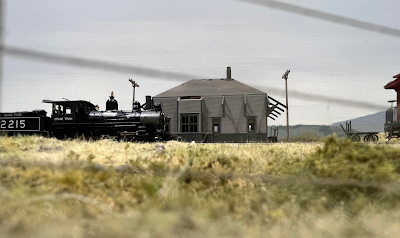
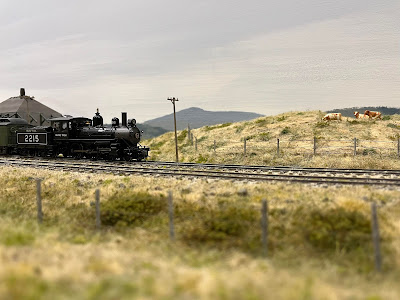
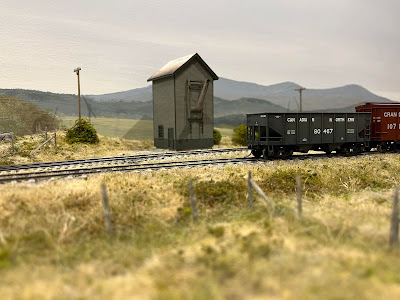
GTR 2215 sitting idle at Stanstead Station, circa 1914

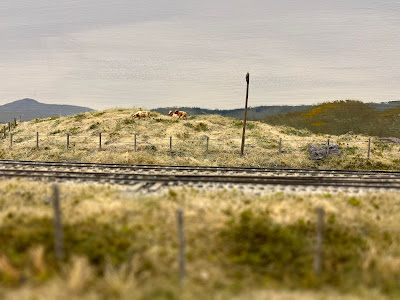
I’ve been torn apart about what to present, but after a few discussions, I became clear my work on the Stanstead diorama would make a lot of sense. Over the last few months, I’ve sensed a lot of interest in smaller subjects to model and it seems there is a lot of latent desire to model pre-nationalization railways in Canada.

The clinic will explain how this small rural diorama slowly made its way in my mind, the challenges of modelling pre-1918 Canadian railways, kitbashing and printing decent models using easily readily available data and finding efficient ways of building a layout. This project wasn’t about getting everything 100% right, but rather about proving you can do a lot if you are ready to leave being you the RTR approach.

The clinic will be held on May 4th at 7:05 PM Pacific Time on Zoom. For more information and access links, please visit RMMBC 2023 page. To be noted, good friend Chris Van der Heide will present his excellent work on creating prototypically accurate wrapped lumber loads for freight cars. Having experimented myself with his technique, I can say it is an essential one for modellers interesting in Canadian railways in the modern era.

See you soon!


Friday, March 10, 2023

Clermont - Lawns and grass

The latest work session on the club layout was all about completing the village scenery. Louis-Marie has been very adamant about it for a few months and it’s long time due to act.


The goal is always to blend everything together in a coherent picture

Having learned new techniques on how to create grassy patches of vegetation with Stanstead, I decided to reuse them for the small rundown farm house. If the houses on the other side of the road have very well kept lawn, this is not the case with the old farmstead.

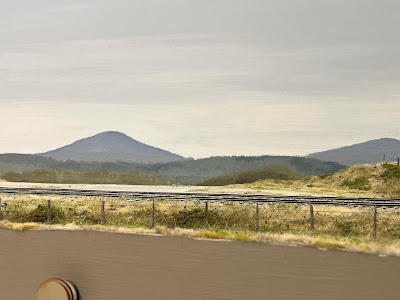
On the horizon, straw colored grass blends with the backdrop 


I applied a generous coat of white glue, pinched static grass of varied length and color and dabbed it. It was all about creating random patches, but also taking into account where dead grass is more prevalent and were new growth manifests first. In that regard, the photobackdrop had that caracteristic straw colored field at the junction with the layout. I thus used static grass of similar color to blend the photo with the 3D world.

The randomness follow patterns observed in real life

As always, I also sprinkle ground foam and dead leaves to add texture and create the illusion of weeds growing everywhere in a haphazard way.


Well-kept lawn at right and untidy grass at left

As you can see, the difference between the manicured lawns and the more natural one is striking. One looks very artificial wile the other is organic and blends together with the rest of the scenery. There is indeed a lot to be learned about applying static grass that go far beyond using an applicator.


I’m also myself impressed by how far my modelling has gone. It is reaching levels far beyond my initial expectations and I’m delighted at what I see taking shape before my eyes.

Thursday, March 9, 2023

Model Railroading as an Art

Many years ago, when I launched my series of “Thinking Out Loud” articles, I had that urge to shout my anger at my approach to the hobby. It was a call for freedom of thoughts in a hobby where I felt I had to check boxes. It was more against my own delusion than the hobby itself, which can be practiced in various ways. Almost 10 years later, as my modelling skills mature, I have the great satisfaction to have finally found my groove, or should I say, my own personal style. Sure it has been informed by many modellers, but I’m far beyond copying others and expecting “realistic” results. Like a painter, I look at a scene and reinterpret is using my own palette.

And to be bluntly honest, it has been quite a surprise. It’s not exactly the way I expected my work to turn out. I has a rougher edge than previously imagined in my mind, but it is counterbalanced by texture and colors, two things that I learned to appreciate.

There is this myth that recipes exist in model railroading, which is true. However, these are tools we master to acquire a vocabulary. They shouldn’t be restrictive but enable us to tell the story we want to craft for ourselves and others.


I’ve learned to frame scenes, I’ve learned to balance space around tracks, to create natural landforms that compliment trains… I’ve also learned I don’t care about what is exceptional in railroading, preferring to put my effort on mundane things, the ordinary life and way we appreciate real trains. Lowly boxcars, unassuming houses and F-units are, as they should always have been, part of my vocabulary. Techniques are no longer how-to but extensions of myself, like a pen and a brush.

I used to draw a lot when I was a kid, mainly landscape with farms, old houses and trains… this passion of mine somewhat died out when I reached college years. Yet, progressively, this old passion of mine is blending seamlessly with model railroading, which makes me wonder if I’m no longer building layouts but drawing 3D train landscapes. Deep inside me, I’ve always wanted to build layouts like you paint on a canvas and it seems I’ve stumbled on that road in a clumsy but rather fascinating way.

Saturday, March 4, 2023

Stanstead - Painting a Backdrop

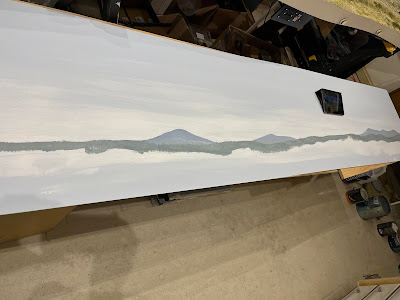
 I've always been a little bit intimidated by backdrop, be they photo or painted. For some reason deep inside me, I'm afraid of ruining my work. But as they say, if the mountain doesn't come to you, go to the mountain.


I suspect my fears were fuelled by the fact I had a very vivid mental image of what should be the correct backdrop for Stanstead and felt I wouldn't succeed to make it reality. Fortunately, I have a few cheap 1/8" MDF panels laying around, so I can afford to miss and redo the job. One thing was sure, I've been a big fan of Mike Cawdrey's painted backdrops for more than a decade and I wanted to try it myself.


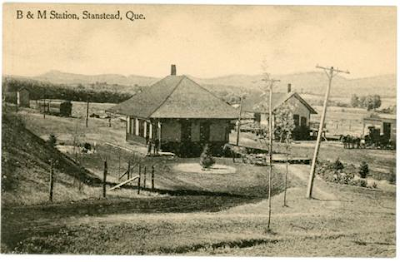
My idea for the backdrop was informed by two pictures. One is an old postcard of the station, looking south toward New Port, Vermont with Jay Peak visible far away on the horizon.

Source: Eastern Townships Archives Portal


The second picture was from the late 1970s, shot at Highwater, QC, looking again toward the Jay Peak and I felt the mix of Appalachian mountains and rolling hills was perfect for Stanstead. To give me some help, I screenshot a view from Google Earth as inspiration and started to paint the backdrop.

Inspiration picture from Google Earth


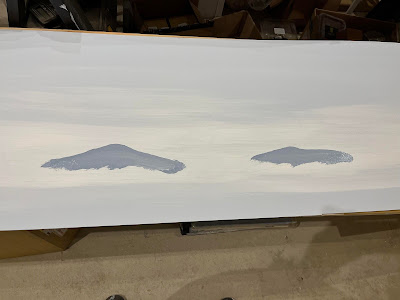
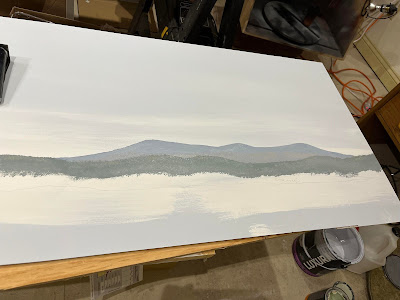
The project started with a very light blue color which I used extensively on Charlevoix Railway. Using white, I feathered both colors to create a bright horizon and a darker sky just like my reference picture.


The second step was to draw the mountains profile with a somewhat darker blue-grey. What is interesting to know is the peak looks darker than the mountain base due to the atmosphere. I dabbed a lighter shade there and even added some burnt Sienna to it to get that warmer tone depicting deciduous trees.


It is then followed by a conifer tree line on the horizon. Once again, several shades of the same color are used to create depth and variation.


Then, the foreground is painted, including several wooden areas, bushes and fields which colors are selected to blend with the layout scenery. It really is that step that helps to tie everything together. Many details at the bottom of the painting will be lost behind the scenery. Is it a shame? Not really, as I believe the horizon line should be low and that mountains shouldn't be higher than structures surrounding them.


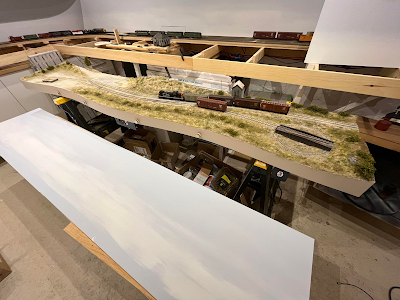
After two hours and 30 minutes of drying time, the backdrop was ready for installation.


At the end of the day, I've learned I can paint decent backdrops, that it's faster than stitching and tweaking photoshop pictures, and that it doesn't need that much talent. Could it be a interesting option for Monk Subdivision? Most likely because I don't see myself fighting with photos in such a crammed space.


Saturday, February 18, 2023

Weathering in the Steam Era

We generally have that idea that color reference pictures before the 1950s are inexistent when dealing with car weathering but as countless Morning Sun books and internet photo archives show us, it's far from being right.


Lots of Autochrome (the commercial name for color photographic plates used in the early 20th century) pictures survives and trains were of major interest to photographers. Jack Delano's pictures are for the right reasons extremely famous and should remind us the the world in black & white never existed.


Over the last year, I've been looking at Jack's and others' railroad yard pictures. They are often shot from a raised embankment, a roof or an overpass which means you have an excellent look at the roofs. This morning, by sheer luck, I stumbled upon an October 18th, 1932 photo of the West Bottoms and Kansas City Stock Yard by Frank Lauder. Compared to Delano's, it's a plain and boring picture which doesn't share the highly artistry associated with Jack's work. Even the colors are that well preserved, but it does show an important thing: the car roofs.
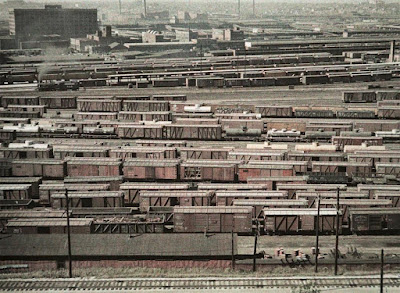
West Bottoms and Kansas City Stock Yard, October 18th, 1932 (credit: Frank Lauder, Kansas City Public Library)

Two things strike me the most. First, how washed out the freight car paint looks to be, covered in dust, soot and rain. They are no longer vibrant, but seen through a filter of dirt and UV fading. We often see modellers weathering their cars and as they move forward with the steps, it just makes it look darker and darker. In my mind, this is a mistake for two reasons.: First, color doesn't scale and small object should always be painted lighter than their real prototype to compensate for that. Second, weathering add layers of darker washes. They alter drastically the car color, meaning we should fade them much more than anticipated to take into account that filtering effect. This is a point Martin Kovac, the armour modeller, often stresses out. You need to make things much more drastic because weathering darken colors and tone down the contrast. This is a reason why I nowadays add a lot of white and buff to my initial color. I've also restarted using drybrushing to highly details that will be, eventually, covered in darker stuff. People who paint stonework knows how you can start with the most garish colors and bring them together later on with washes, filters and dirt. Ryan Mendell, at Binbrook RPM two weeks ago, called it the "rainbow effect" because it looks so silly when you start, yet makes sense at the end of the process.
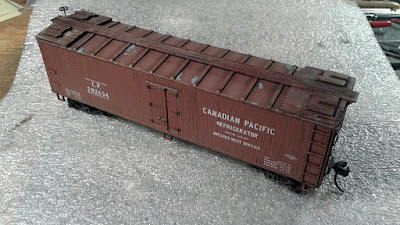
This Accurail reefer has been drastically faded with white and buff filters

My second observation is about horizontal surfaces such as car roofs and tank tops. Look at them in the picture. They are covered in coal soot, yet they are the so light colored they almost look off white. You can barely discern the original red oxyde or brown paint, yet they are not black or dark gray. Like the previous effect, light plays a role in that perception. Horizontal surfaces receive much more sunlight than vertical ones, making them look brighter. Just like the albedo on the Moon surface is in fact very dark since it's mostly made of basalt, but direct sunlight over the powdery surface makes her look white at night. The same happens with our cars. And the powdery observation too! Indeed, soot is a powder than collects on horizontal surfaces and dirt and dust get mixed with it. It's no longer dark grey, but rather a light grey color. For this reason, I've recently started to paint my car roofs much lighter than the car sides to help me capture that effect. Not only it looks better and more realistic, but it also gives more depth to the car itself, it looks more 3D even if it sounds absolutely silly to word it like that. At the end of the day, it enhances that impression of looking at wood or steel instead of plastic.
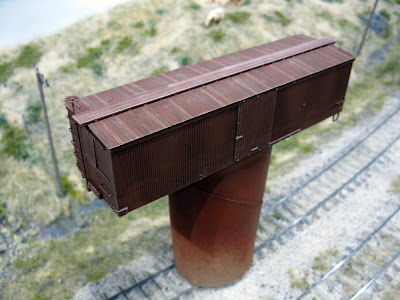
The wooden roof on that car is noticeably lighter than the sides