Wednesday, December 18, 2013

MLW RS18 Madness - Part 1

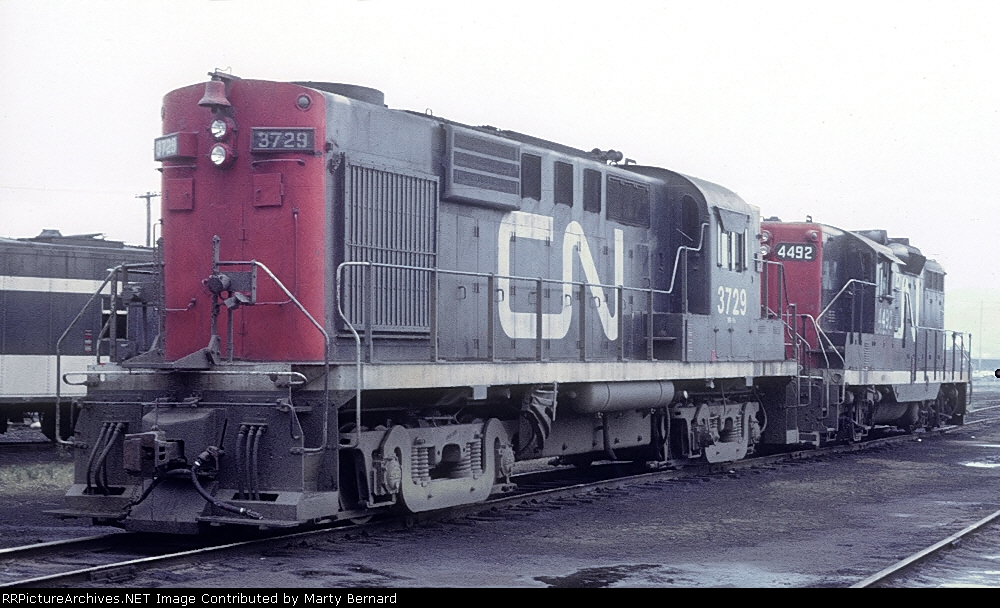
I've been inspired by Marty Bernard's pictures of Quebec City in 1970 for a while. As I said in a previous post, he did a fine job in depicting the roster of an ordinary day.

Thus, I decided to make a fleet of MLW RS10/18 to have motive power on hand for operation purpose.

I already had an Atlas/Kato RS11 on hand from a former CPR/MEC ill-fated switching layout. Also, one of or best runner on the layout is an excellent DW&P Atlas Classic RS11. A fine exemple of a pleasing locomotive to run.

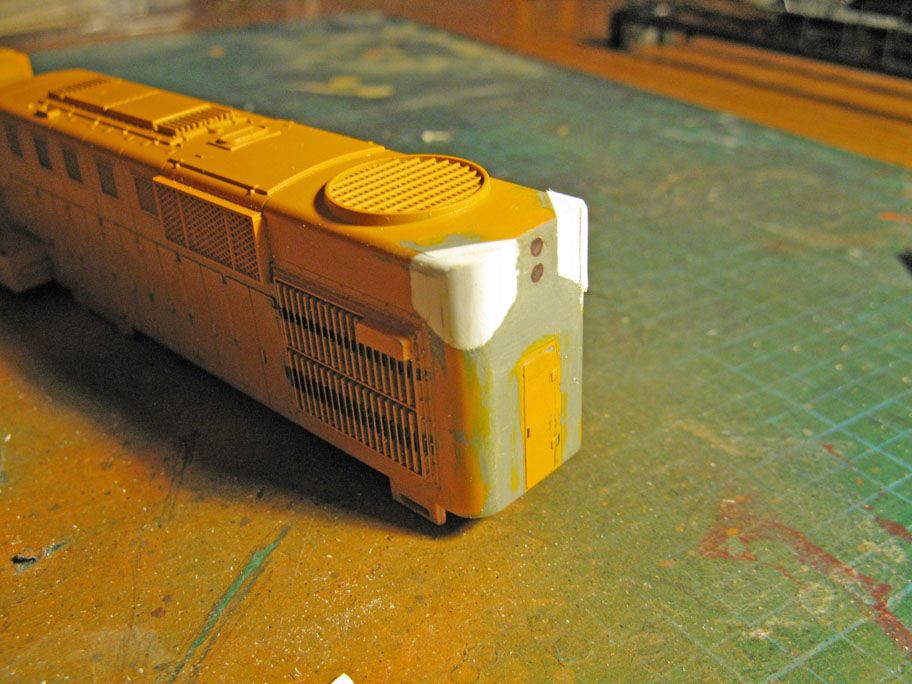
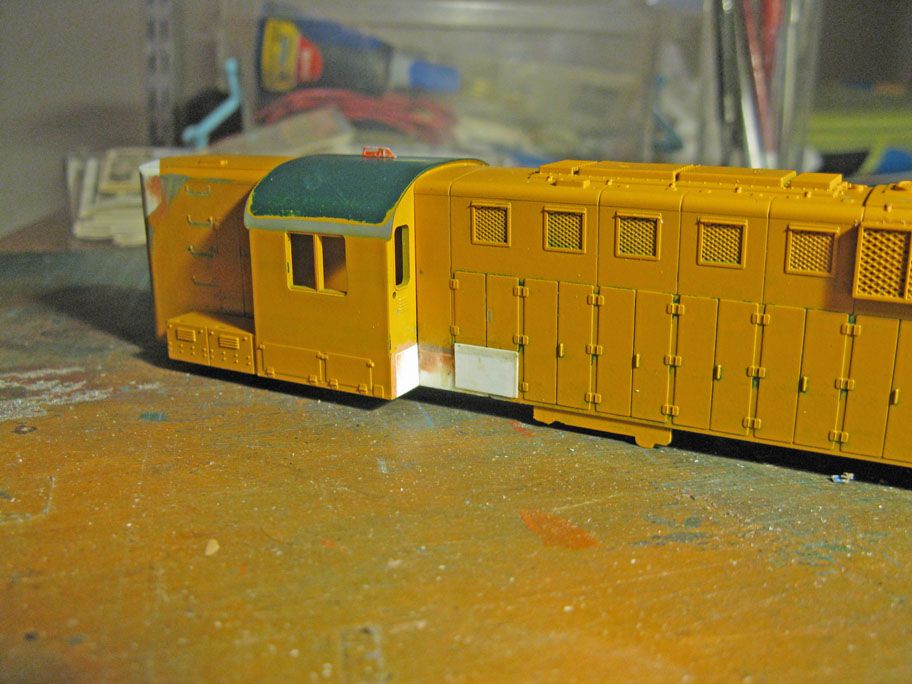
Since I'm fighting a nasty cold since last week end, I decided to think about how I would tackle the project. In the end, it appears the kitbashing proposed is relatively simple and straighforward. Using the Atlas/Kato locomotive as a guinea pig, I started some bashing to find out the most efficient way to convert this locomotive. It shoudn't be to hard.


Today, I found out my best bet was getting Atlas Trainman RS32 shell and scavenge them for parts. At 4 bucks a piece, it's almost free and save a lots of work!

Also, I discovered using the Atlas Classic revised version was the best option. Since it's more accurate, there's less work, fewer commercial parts to get (saves money) and the wheelbase is correct. BTW, second-hand newer RS11 aren't that expensive compare to some Atlas/Kato version.

I was also able to work some details out while discussing the project with fellow modeller Wayne Toth whom experience in kitbashing spans decades and hundreds of models. I'm confident the price of each unit should be about 125$ once completed - including the decoder and acquisition price. It far cheaper than getting a Proto 1000 RS10/18 which dimensions are off at many places. Also, I can freely detail each unit according to the prototype.

I also set my mind on which unit I will model. I really wanted locomotives that worked in Quebec City at some point in their respective career. Thanks Marty Bernard, I know what to do now:
  • Canadian National MLW RS18 #3714
  • Canadian National MLW RS18 #3729
  • Canadian Pacific MLW RS10S #8586
  • Canadian Pacific MLW RS18 #8800

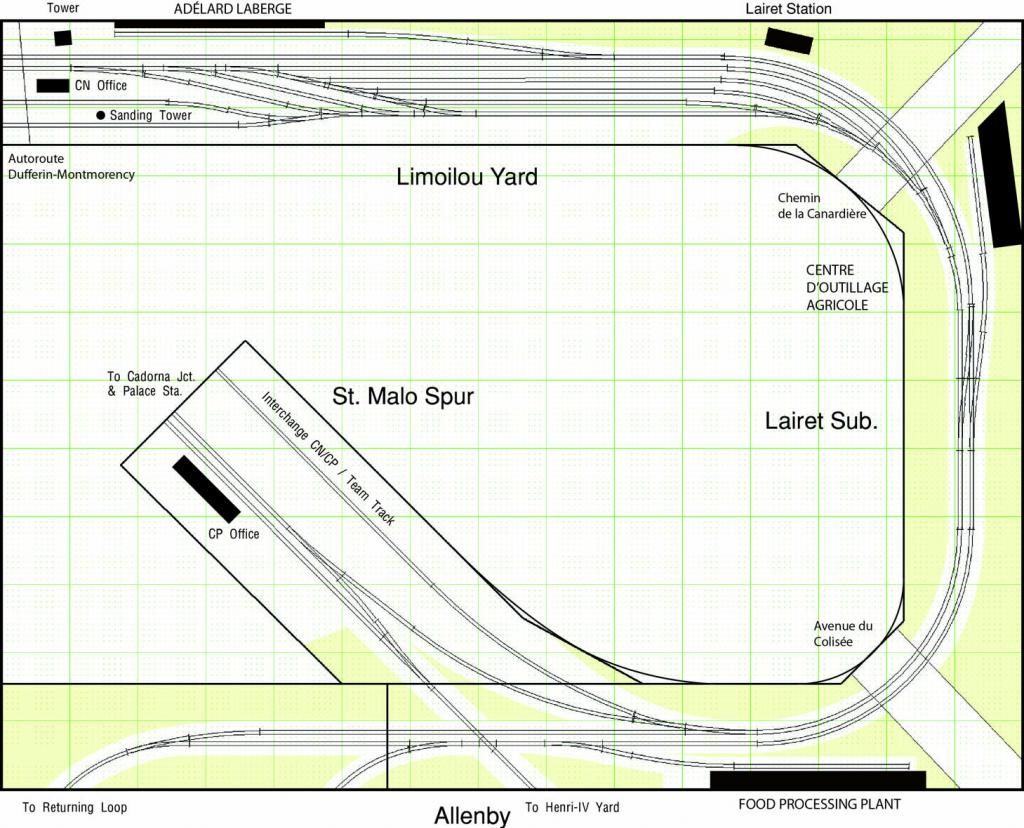
Lairet Subdivision : Updated layout plan

As the moment to receive tracks and rebuilt the layout is nearing, the Lairet Subdivision layout plan is maturing.

I had the pleasure to discuss a lot with good railfan friend Jean-Pierre Veilleux who knows Quebec City area since is childhood in the 50s. His input conforted the club choices over track arrangement. Leaving the anecdoctical aspect of the area, the layout will focus on industrial switching on Lairet Subdivision, a 5-mile CN former subdivision that covered our area from Limoilou Yard to Allenby Jct with CPR. Not depicted is Hedley Jct itself that connected St. Raymond Subdivision (to Chicoutimi) and Murray Bay Subdivision south to Limoilou Yard at Hedleyville (which is staged and hidden in the furnace room left to the yard).

If you want a good idea of Limoilou yard in the early 70s, take a look at Marty Bernard's collection. Very impressive exhibition of first and second generation diesel locomotives.


Modifications are minor but make a big improvement. I decided to rebuild the peninsula at 45 degrees to use commercially available crossings at Allenby. This new design makes the room larger and can accommodate easily two operating team. Until recently, operators at Limoilou yard were obstructing the only aisle in the room.

Also, it makes Allenby more similar to the real thing. Curves are gentler and longer which helps make things look bigger than they are.

Not seen on the layout plan is a rebuilt returning loop in the storage. Minimum radius is now 24 inches instead of 18 inches in the hidden part. Much before operation-wise.

On visible parts of Lairet Sub, minimal radius is 32" with an average of 36" on mainline. Maximum goes at 78" at Allenby. Mainline turnouts are #8, yard is made of #7 curved turnouts and #6 turnouts. "Large enough for passenger traffic, but designed for freight operation."

Personally, I love to see trains flowing smoothly on gentle curve, makes the best pictures!

Monday, December 16, 2013

Locomotive Roster - Part 2

Marty Bernard's journey to Quebec City in August 1970 gives us a good idea of locomotives working there on a typical day. He bothered to photograph almost every locomotives he encountered that day, making it an almost perfect snapshot.

Using his pictures, I was able to get a quite precise idea of the roster. That way I was able to figure out how many locomotives of each type could be found at Quebec City. Then, I scaled down the number of units to represent the fact our layout is about half the size of real life operations.

Number per type reads as 2 (1) [1].

2 stands for the number pictured by Marty Bernard.
(1) is half that number to fit the layout
[1] is the adjustment I make to make it more realistic
Then some pertinent remarks as needed.

Canadian National:

C424: 3 (1.5) [2] - I rounded at 2 because they always run in pair and 1.5 is practical! I have one Atlas in wet noodle [#3214] and 1 Atlas-Kato in zebra stripes [#3201] (may need a repaint or to get another one in the right scheme since Atlas Classic locomotives are better detailed).

GP9: 6 (3) [3] - The work horse at Quebec City. I have 2 new Bachmann waiting their new paint scheme [#4492 & 4521] and probably will need another one, probably a Bachmann to have a consistent fleet at low price. Or maybe a Proto 2000 in green/gold livery since there's photographic proof one still operated at Limoilou in 1967 [#4509].

RS18: 3 (1.5) [1] - I'll have to get and bash an Atlas Classic RS11 [#3714]. I already gathered the detailing parts. Since it's a serious and costly bash, I don't expect to make a second one.

S4: 2 (1) [1] - The club has an Atlas GT S4 that will be detailed and painted to fit one of Quebec City switcher [#8176].

FPA4: 4 (2) [1] - The main passenger locomotive in Quebec City. However, since we don't model Palace Station, I feel it's useless to get more. I already have a Proto 2000 PA4 in CN livery that will make a good stand-in [#TBD].

B-units: 2 (1) [1] - EMD and MLW, only needs one to complete a set [#TBD]. Since FPA4 often pushed short local trains in the 70s, I'm not in a hurry to get one. Maybe a Rapido in the future, who knows.

Steam Generator: 4 (2) [1] - Lots of freight locomotives pulled trains in Quebec City area, mainly on Murray Bay Sub [#TBD]. Since we don't operate passenger trains, getting one from Rapido would be more than enough.

Budd: 1 (0.5) [1] - Acquiring a Budd in the future would be a nice move to get the feeling of the era. But it's not a priority so far [#6116].

Wood caboose: 2 (1) [2] - I already have a True Line caboose in wet noodle. Since we operate many freight trains, I have also built a Sylvan Scale resin Pointe Saint-Charles caboose that also fits the era.


Canadian Pacific:

RS10: 2 (1) [1] - We already own a Proto 1000 in Multimark scheme.

RS18: 2 (1) [1] - Building a RS18 is a costly and lenghty endeavour. If I can grab a Proto 1000 specimen in Maroon & Grey scheme, it would be a possible way to add it to the fleet.

S2-S3: 2 (1) [1] - I have a Proto 2000 S3 in Maroon & Grey scheme, block lettering).

Budd: 2 (1) [1] - Would be a nice future addition to depict passenger operation at Saint-Sacrement Station.

Wood caboose: 1 (0.5) [1] - I own a True Line version in Script scheme as found at Palace Station on 1970s pictures.

Steel caboose: 1 (0.5) [1] - We've got a Rapido Transcona caboose in Multimark scheme as seen on era pictures.


National Harbour Board:

GE 44-Ton: 1 (0.5) [1] - I already repainted a Bachmann Spectrum in the correct paint scheme.

***

Other locomotives will be added to this preliminary roster. In fact, other locomotives such as M630C weren't unusual on CP Rail intermodal trains to Wolfe's Cove. I already got one from Bowser. Also, M630C were also a common sight in Quebec area, pulling long intercity freight trains, including grain trains. I also have two Bowser unit in wet noodle and zebra stripes schemes.

Finally, GP38-2W, GP40W and M420 were often seen in the mid-1970s. So far, we got two Atlas GP38-2W in zebra stripes.
Sunday, December 15, 2013

Locomotive Roster - Part 1

Setting the layout in a 1972-1976 bracket made me wonder about locomotives used in Quebec City at that time. Quickly, a coherent fleet appeared. Pictures used are from Marty Bernard, Gerry Burridge and a few other collections available over Internet. This overview will help me to build the required fleet. So far, I've got most models needed thought many need redetailing and repainting to better represent the prototypes. Models are Life-Like Proto 2000, Atlas Classic, Bowser and Bachmann (new generation).

Canadian National:

Most locomotives are in CN Wet Noodle scheme (post-1961).

C424: #3222, 3236, 3212 (Always paired, sometimes with a GP9, for freight trains)

GP9: #4101, 4105 (excursion trains in Charlevoix), 4423, 4492, 4455, 4463, 4509 (green and yellow scheme), 4521 (Alone or paired, always with a steam generator while pulling a passenger train. Definitively the multi-purpose work house in the area.)

RS18: #3714, 3729 (pulling passenger and freight trains.)

S4: #8176, 8189 (Yard switchers.)

FPA4: #6768, 6769, 6771, 6786 (Alone or paired with a B unit.)

FPB4: #6863 (Paired with a FPA4.)

F9B: #6635, 6863 (Paired with a FPA4.)

RDC1 Budd: #6116

Caboose: Older wood type with wet noodle scheme and Pointe-Saint-Charles design.


Canadian Pacific:

Most locomotives are in CP Script Maroon & Grey scheme.

RS10: #8580, 8586

RS18: #8779 (Multimark), 8800

S2: #7013 (Script, this yard switcher was assigned to Quebec City for a long time.)

S3: #6523 (Block)

RDC1 Budd: #9055, 9309 (all Multimark)

Caboose: Older wood type with Script scheme and Transcona design (Multimark).


National Harbour Board:

GE 44-Ton: #1

Friday, December 13, 2013

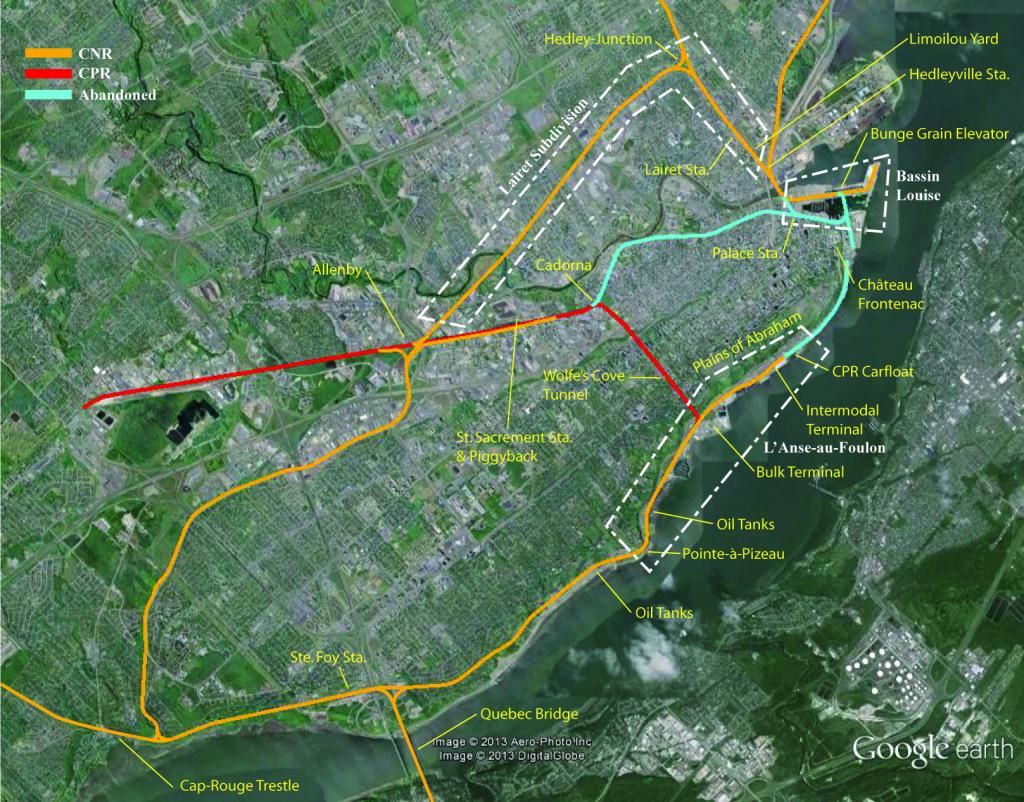
Some lesson of Geography


I’ve been talking a lot about this layout but never really presented a comprehensive understanding of the area. Quebec City never was an important rail hub but rather a secondary terminal. For this reason, I don’t expect railfans across the nation and worldwide to know it. Nowadays, rail transportation is rather minimal here compared to what it used to be. But truth to be told, there’s still a lot of action, mainly in handling of bulk commodities like grain, alumine, coal, jet fuel, fertilizer, salt and others. Quebec City is also home of Canam-Structal plant shipping many steel bridges and building structures by rail all over North America.

On the map, most important railway related features of the city are presented. Also, some well-known landmarks as Château Frontenac, Palace Station (terminal of VIA Rail Corridor) and Plains of Abraham where Canada’s fate was decided in 1759. CNR tracks are orange, CPR tracks are red and abandoned tracks are blue.


Three areas inspired our layout, namely “Lairet Subdivision” located in Limoilou Ward, “Bassin Louise” which is Quebec City old harbour and “L’Anse-au-Foulon” (Wolfe’s Cove) which is a bulk terminal.

Our layout isn’t an exact reproduction of these areas, but still faithful enough for someone to recognize clearly them in HO scale.